Break-Even Analysis for Per-User Agent Deployment
Idle time, not active reasoning, drives per-user agent costs.
A per-user agent fleet does not behave like a SaaS product, and pricing it like one guarantees a loss on the heaviest users or a margin so thin it collapses at scale. Whether an agent fleet's architecture treats idle time as a compute cost or a storage cost is the real question in 2026, because that single decision, more than any pricing strategy, decides whether the economics close.
The cost logic per-user agent deployment breaks in traditional SaaS
A seat-based license works because the cost of serving a user barely changes whether that user logs in once a month or fifty times a day. Agent deployment does not share that property: every interaction carries a real, variable compute cost tied to what the agent actually does, not to the fact of the user having an account. An agent user running a high volume of tasks costs dramatically more to serve than one running a handful, and if both pay the same seat price, the light user is effectively subsidizing the heavy one.
Pickaxe's 2026 analysis names this break directly: the seat model assumes a fixed cost per user, but agent cost tracks consumption, and a single query's compute cost can swing by a factor of 10 depending on how complex the input is. Agent workloads invert that assumption: the marginal cost of use is the dominant cost, and that cost is also the least predictable one.
Buyers have started pricing this reality into their procurement decisions before vendors catch up to it. Futurum Research's Enterprise Software survey found that fewer than one in five enterprise buyers still prefer per-user pricing models, with a large majority favoring consumption-based or outcome-based structures instead. That shift did not happen because per-user pricing is unpopular as a concept. It happened because buyers have already seen what a flat seat fee does to a bill once agent usage scales, and they are no longer willing to absorb that risk on the vendor's pricing terms.
The four cost dimensions a break-even model must account for
A complete break-even model for per-user agent deployment requires four distinct cost dimensions, tokens, compute, storage, and orchestration, and collapsing them into a single "AI cost" line item produces a model that will be wrong at scale.
Token cost is the cost of inference per task, and it escalates fast once an agent runs multi-step reasoning loops rather than single-turn chat exchanges. Compute cost is the cost of actually running the agent process, and it is here that idle time, rather than active reasoning, tends to dominate the bill for a fleet of many users. Storage cost is the cost of persisting an agent's state between uses, and under the right architecture it can substitute for compute cost almost entirely during idle periods. Orchestration cost covers tool calls, retries, human escalations, and the engineering work of managing an agent's lifecycle across a fleet, and thecrunch.io's 2026 breakdown names integration and setup as a cost that adds substantially to first-year totals and gets underestimated at the planning stage.
Idle compute as the dominant cost driver in a per-user fleet
A persistent agent spends most of its existence waiting, not reasoning, and the way a fleet handles that waiting time decides whether the deployment is profitable or structurally underwater. An agent instance sitting idle between user messages, waiting on a human approval, or paused between scheduled runs is not doing any useful work, but if it is architected as an always-on process, it is still billed as though it were.
Treating every agent in a fleet like an always-on server means paying full compute cost for each one around the clock, regardless of how much of that time is spent doing nothing. Across a fleet of thousands of per-user agents, it becomes the single largest line on the bill, because the inefficiency multiplies by every tenant rather than averaging out.
The AWS builder.aws.com engineering analysis of a per-tenant Firecracker microVM fleet makes the magnitude concrete: a VM that runs active for a short window and then sits suspended for an extended stretch costs a small fraction of what the same VM costs running always-on, and a fleet made up mostly of dormant tenants in a suspended, snapshotted state collapses down to a modest storage bill rather than a heavy compute bill. That is the structural argument against always-on architecture for per-user fleets: the fleet's total cost is set by how it handles the tenants doing nothing, not by how it handles the tenants doing the most.
The usual objection is that suspending and resuming agent processes adds engineering complexity and introduces latency that users will notice. That objection does not hold once restore times are fast enough to be invisible: restoring from a local NVMe snapshot can complete in under 30 milliseconds, and at fleet scale the economics of keeping every agent always-on simply do not close.
Why Firecracker micro-VMs with snapshot-restore change the storage-vs-compute trade-off
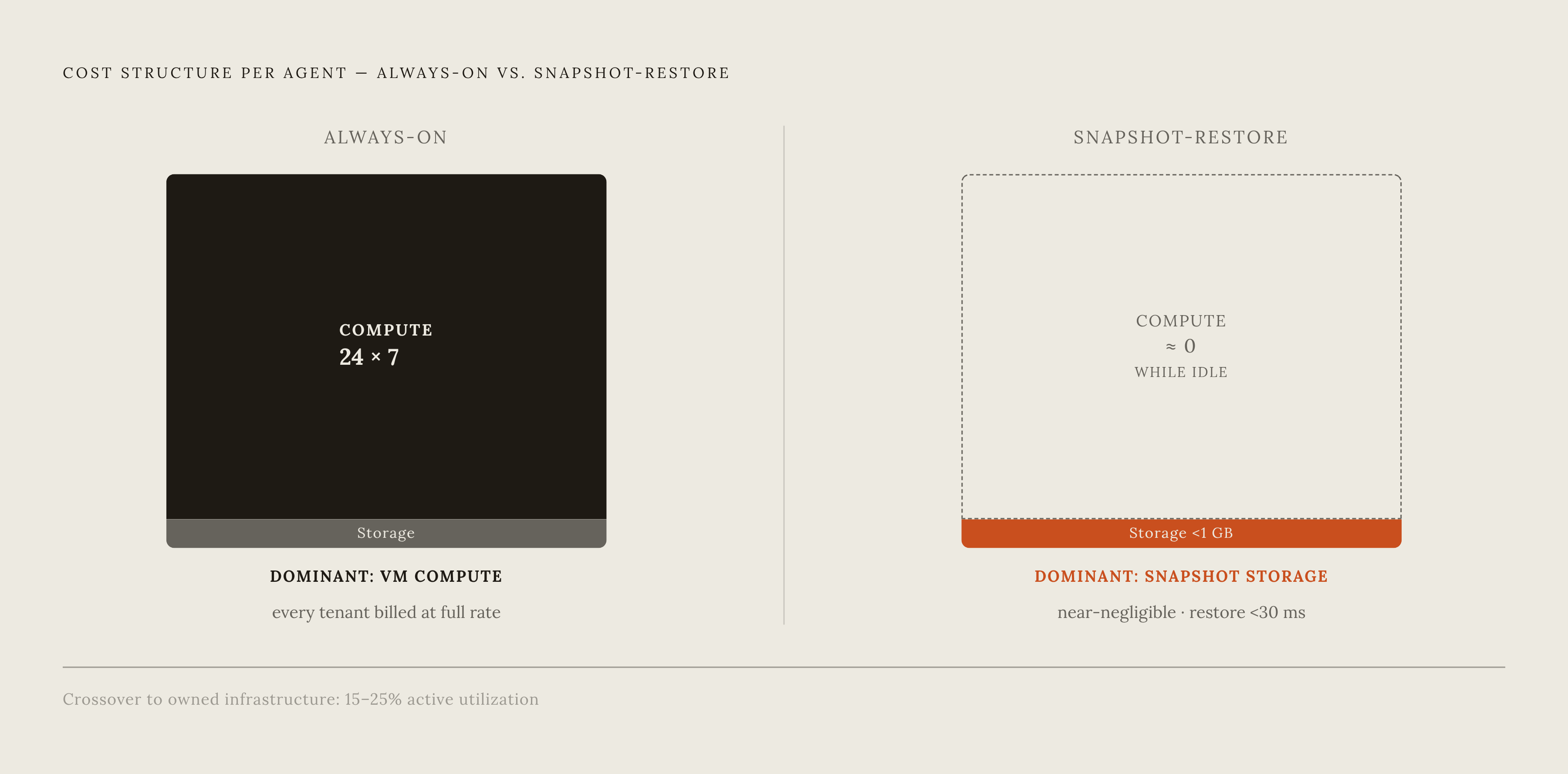
Snapshot-restore on Firecracker micro-VMs turns the cost of idle agents from a compute expense into a storage expense, and storage is cheap enough that this conversion is what makes per-user agent deployment viable at real scale. The mechanism is straightforward: a microVM boots to a ready state, its full memory and block device state gets snapshotted to durable storage, and when the agent needs to act again, the process restores from that snapshot rather than cold-booting from scratch, with sandbox creation from snapshot landing under 30 milliseconds against a far slower full cold boot.
While an agent is snapshotted and idle, the process itself has terminated, compute cost drops to zero, and the only ongoing charge is for storing the snapshot. The AWS analysis puts that dormant-tenant cost at roughly the price of storing a snapshot under a gigabyte in size each month, a number small enough to be close to negligible per agent. Multiplying that by a fleet where most agents are idle most of the time, as most real fleets are, produces a total bill that looks nothing like what an always-on architecture would produce.
Memory handling at fleet scale compounds the savings further. Restored guests read from shared template pages using copy-on-write, and only allocate their own private physical memory once they actually write to it, so a hundred sandboxes restored from a common template consume far less total RAM than a hundred fully independent VMs would. That matters because per-user fleets are, by definition, running many near-identical agent instances from the same base configuration, which is exactly the pattern copy-on-write memory is built to exploit.
Cheap is not the only argument for this architecture. Each microVM gets its own dedicated Linux kernel rather than sharing one with other tenants the way containers do, so a kernel-level exploit inside one agent's sandbox cannot reach other tenants or the host system. That isolation guarantee is what makes per-user agent deployment safe to run at fleet scale, not merely affordable to run.
None of this means every team should build its own Firecracker fleet. The managed sandbox market has a clear utilization inflection point: at low active utilization, renting managed infrastructure beats owning it, and the economics flip toward building and operating it in-house only once utilization is sustained and high, with the crossover landing somewhere in the 15 to 25 percent active utilization range. Below that line, the fixed cost of operating the infrastructure outweighs what owning it saves.
Token cost optimization: where prompt caching fits in the break-even model
Prompt caching belongs in a break-even model as an infrastructure decision made when a fleet is designed.
The cost of getting this wrong is not abstract. A developer's "Current Date & Time" system prompt bug illustrates the failure mode precisely: a timestamp embedded in the system prompt changed on every request, which invalidated the cache on every single turn, so a large context got fully reprocessed each time instead of being read from cache. Cache reads sat at zero, and costs ran an order of magnitude above what the developer expected, with no visible error to flag the problem. That is the risk a break-even model has to price in: a single architectural mistake in how a system prompt is constructed can silently erase the entire benefit prompt caching was supposed to provide.
Done correctly, caching compounds its benefit across exactly the kind of multi-step reasoning loops that make agentic systems expensive to run. If a five-step agentic loop reuses the same context prefix at each step, rather than reprocessing the full context from scratch every time, the effective token cost of the whole loop drops sharply compared to naive reprocessing. For a per-user fleet where every agent runs a stable persona, a fixed set of permissions, and a persistent memory prefix, that prefix is the natural target for caching, because it stays constant across turns even as the rest of the context changes.
Orchestration and escalation costs that most break-even models omit
Orchestration cost, covering retries, tool calls, human escalations, and integration overhead, is the category most likely to invalidate a break-even model that looked sound at pilot scale, because it is close to invisible with a small user base and becomes non-linear once volume arrives.
Every agent step that fails and triggers a retry doubles or triples the token and compute cost of completing that single task. At production volume, with thousands of tasks running per day, it becomes one of the largest cost centers in the entire model, simply because the number of opportunities for failure scales with the number of tasks.
The DestiLabs e-commerce returns agent shows both sides of this at once. Handling a large majority of return requests without any human intervention saved substantially on monthly support labor and reached break-even in under four months. That saving holds only as long as the resolution rate holds: if it drops, escalation volume rises, and the model that looked profitable at launch erodes along with it.
Integration cost sits on top of all of this as a one-time but often underestimated expense. Connecting an agent to a CRM, a helpdesk platform, or an e-commerce system adds a material amount to the initial budget, and that amount rises significantly when the system on the other end is a legacy platform not built with agent integration in mind. That upfront cost has to be amortized into the break-even timeline rather than treated as a sunk cost that disappears once the agent goes live, because it is the reason a fleet's break-even point often lands months later than the per-task economics alone would suggest.
Activity patterns across a real user base and the break-even curve
Break-even for a per-user agent fleet is set by the shape of activity across the entire user base, not by what the average user does, and most real user bases are skewed sharply enough that the average is close to meaningless on its own. A small fraction of users typically drive most of the agent activity in any fleet, while the majority of users are infrequent or outright dormant for long stretches. That skew is why the snapshot-restore architecture matters as much as it does: if most agents are idle most of the time, the fleet's true average cost per agent sits much closer to the idle cost than to the active cost, which is the entire economic case for converting idle compute into idle storage.
Salesforce's own pricing history with Agentforce shows how hard it is to price agent usage correctly without good activity data. Three pricing models running at once, by Salesforce's own account, reflects how difficult it is to find one structure that works across customers whose activity profiles differ as widely as theirs do.
The same skew produces a scaling trap when it goes unaccounted for. The token burn and retry overhead scaled non-linearly as genuine traffic patterns, rather than pilot-stage usage, started hitting the system.
Because of this skew, a break-even model has to divide the user base into at least three activity segments, dormant, occasional, and frequent, each weighted by its expected share of the fleet.
The infrastructure and cost architecture required to support that kind of load bears no resemblance to what a small fleet needs, which is itself an argument for building the break-even model around activity segments rather than a single fleet-wide average.
Building the break-even model: inputs, assumptions, and the levers that move the number
A rigorous break-even model for per-user agent deployment runs on six inputs, and two of them, the idle compute assumption and the escalation rate, are the ones practitioners get wrong most often. Getting either one wrong invalidates the entire model no matter how precisely the token cost estimate was calculated.
The first input is token cost per task, estimated from model pricing and average task complexity, with an explicit accounting for prompt caching hit rate, since a stable system prompt can cut effective token cost substantially. The second is active compute cost, the price per agent-hour of genuine active inference, which should come from real VM or sandbox pricing rather than a rough estimate built off API call counts.
The third input, the idle cost assumption, is the architectural fork the entire model turns on. Under a snapshot-restore architecture, idle cost drops to storage cost alone, and the gap between those two assumptions is the largest single variable in the model for most fleets. The fourth input is storage cost itself, the monthly price of persisting agent state, snapshots, memory, and credentials, per agent; this becomes the dominant cost for dormant agents once a fleet runs on snapshot-restore.
A model that gets the token cost estimate exactly right but assumes always-on compute, or assumes an escalation rate well below what production actually delivers, will still produce a break-even date that has no relationship to what the fleet actually costs once real users start using it.