Filesystem Persistence Patterns for Long-Running AI Agents
Agents need three separate persistence patterns to avoid repeating work and losing context.

Filesystem persistence for long-running AI agents is not one storage problem but three, namely conversational continuity, execution-environment state, and multi-agent shared access. For agents to work reliably, each layer needs its own pattern. When those patterns fit the workload, agents can pick up where they left off, recover, and work together without paying again for work already done.
Why long-running agents fail at the filesystem layer, not the reasoning layer
An agent can appear to work while silently repeating work or losing context between sessions. A coding agent re-clones and re-indexes a repository, a data-analysis agent reloads a large dataset, and a returning user explains preferences already learned three sessions ago. These failures arise because the infrastructure has discarded something the next session needs.
LLMs have no memory between API calls, so developers must build in every way to carry state from one call to the next. Conversation history, working files, and shared outputs survive only when the surrounding system preserves them. Stateless execution was sufficient for single-turn prototypes because little depended on a previous session. Once work spans sessions, agents need persistence to work reliably, and the storage system does not supply it by default.
Three persistence problems that require different solutions
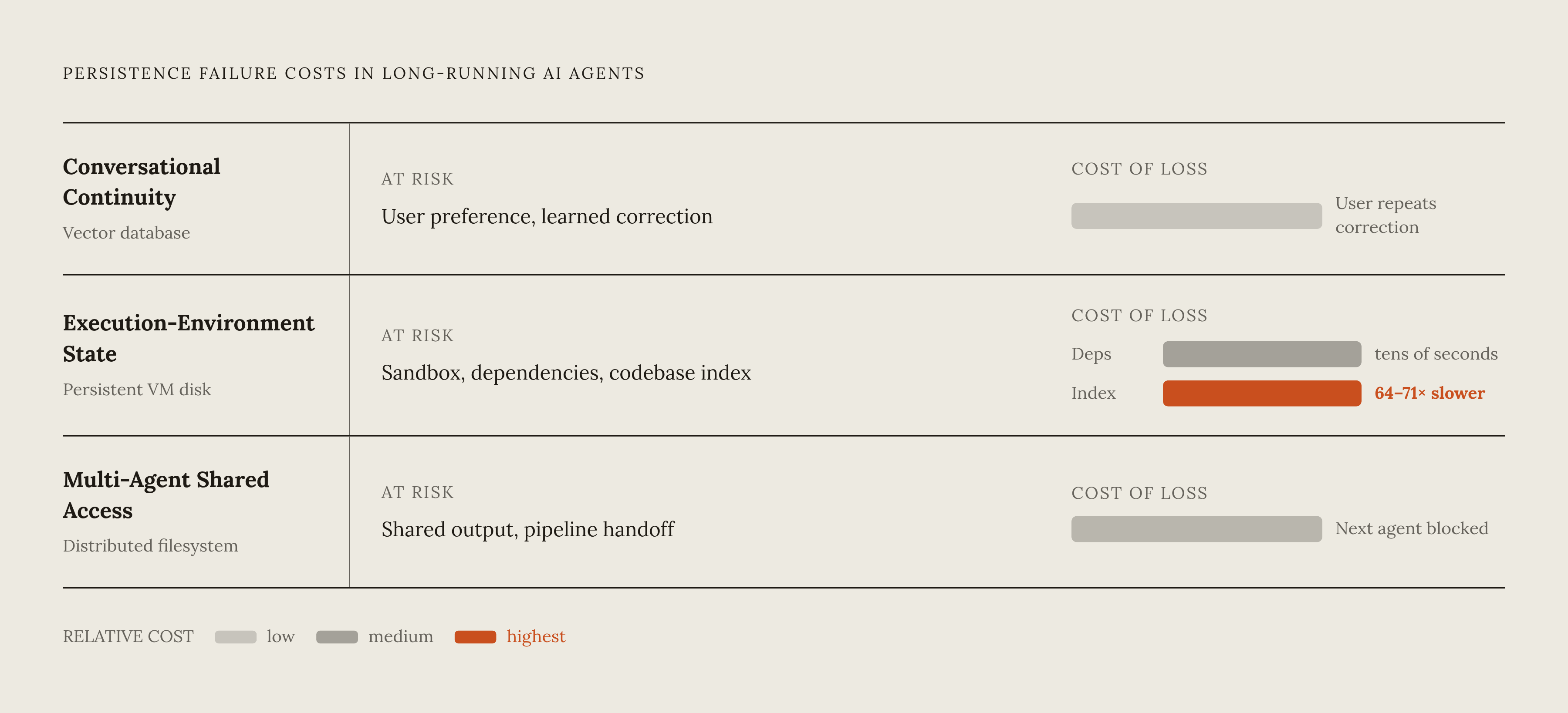
Conversational continuity preserves what an agent has learned from prior interactions, including preferences, corrections, and accumulated context. Execution-environment state preserves the sandbox in which work happens, including filesystem contents, cloned repositories, installed dependencies, loaded datasets, and running processes. Multi-agent shared access makes one agent’s outputs available as another agent’s inputs across machines or sessions. Its concern is the handoff, without requiring explicit serialization into an intermediary store every time.
Although all three can be described as memory, they differ in what must survive, where it must live, and what losing it costs. Losing a preference forces a user to repeat a correction, while losing a prepared sandbox forces computation to start over. An inaccessible shared output prevents another agent from continuing the pipeline. Most production systems need two or three forms of persistence together, but a storage choice that fits one can conflict with another.
Conversational continuity: what belongs in vector storage and what does not
Conversational recall is primarily a semantic problem. An agent needs to find a relevant earlier interaction even when the current request uses different words, which takes more than an exact key lookup. Embedding-based retrieval fits that requirement better than structured logs alone. The pattern converts past interactions into vector embeddings, stores them in a vector database, and retrieves relevant context through similarity search at session start.
However, conversational continuity needs more than a single collection of embeddings. Semantic memory holds structured facts about users, such as preferences and entity attributes, which a key-value store such as Redis can serve with sub-millisecond reads. Procedural memory holds workflows learned for a given user, while episodic memory holds the record of past interactions. LinkedIn’s Cognitive Memory Agent exemplifies a design that connects episodic, semantic, and procedural layers.
Tiering then matches access frequency to storage cost. The context the agent needs most goes in the hot tier, the context window, while facts it reads often go in a warm tier such as Redis and past interactions stay in a cold vector database. Intelligent summarization compresses old conversations, and memory decay expires low-importance facts.
Vector storage nevertheless carries per-query embedding latency and requires a pipeline to generate and maintain embeddings. It is unnecessary for exact procedural bookkeeping, such as recording which loop iteration an agent has reached. The distinction is between recalling relevant meaning and preserving an exact position in a task. Conversational memory solves the returning user’s need for continuity, but it cannot by itself let an agent resume computational work.
Execution-environment state: why saving outputs is not the same as saving the environment
Saving an output to a database preserves only what the agent explicitly serializes. Preserving execution state instead keeps the environment in which that output was produced, including files, dependencies, loaded datasets, memory, and running processes. A saved result can tell an agent what happened previously without giving it the means to continue immediately.
That difference is costly for coding and data-analysis agents. Dependency installation on a typical project takes tens of seconds, and LLM-mediated codebase indexing runs 64-71 times slower than indexing based on syntactic structure. Without persistence, the same setup costs recur at every session, regardless of how often the agent has already completed them.
The storage primitive for this layer is a persistent disk inside an isolated execution environment. The disk preserves the working filesystem, while preservation of the full runtime also requires the surrounding environment’s state. File-based checkpointing offers a narrower form of recovery by writing state to JSON or YAML and uploading it to durable storage. That checkpoint can help after a crash, but it does not restore the full sandbox.
Even this fallback requires atomic write discipline. Writing to a temporary file and then renaming it prevents a crash during the write from leaving the saved checkpoint partially written. Durable-execution harnesses such as Temporal and Inngest meet a related need by keeping workflow execution state so human-in-the-loop tasks can pause without keeping a process running. They still need a persistent environment if computation-heavy steps are to resume without rebuilding the sandbox.
How snapshot-restore changes the economics of keeping execution state alive
The traditional objection to persistent sandboxes is the cost of keeping them running while nothing happens. An agent may execute tool calls briefly and then wait for a human response for an extended period. Continuous compute charges make that idle time expensive when most agents are inactive most of the time.
The system captures the VM’s memory and disk state, evicts the idle sandbox, and restores it in under a second when execution resumes. During the idle interval, the environment consumes only storage. Copy-on-write memory mapping helps guests restore quickly because they can share template memory pages. The kernel allocates a private physical page only when a guest writes to it, so a hundred sandboxes restored from one template do not require a hundred times the template’s RAM.
Google’s Agent Substrate demonstrates this economic logic, with host count following active concurrency. It is available for non-production and evaluation use, with production support only through a limited allowlist. At millions of concurrent sessions, that mechanism addresses the gap between how many agents exist and how many are actually working.
Restore latency also depends on the underlying virtualization design. Sub-200ms restore is tied to demand-paged VMM designs such as Firecracker and Cloud Hypervisor, whereas stock QEMU/libvirt on q35 should be expected to restore in seconds. Hosted-product latency figures therefore do not transfer to arbitrary hypervisors.
Multi-agent shared access: when file-based state breaks across machines
Isolation protects each agent’s working environment, but it also limits collaboration. If Agent A writes a file on Machine 1, Agent B on Machine 2 cannot read it through a local file reference. A multi-agent pipeline therefore needs a coordination layer in addition to each agent’s own persistence.
Object storage such as S3 or GCS can handle those handoffs, but the sender has to write and the receiver has to read each time. Object storage also adds tens of milliseconds of first-byte latency per access through protocol and network overhead. File storage in the same availability zone responds in sub-millisecond to low single-digit milliseconds. For frequent handoffs, a distributed filesystem mounted across execution environments can therefore reduce the coordination cost.
A shared distributed filesystem fits pipelines that repeatedly exchange large artifacts. A research agent can write findings that a drafting agent in a separate session reads directly, without a serialization round-trip through an intermediary store. Database-backed checkpointing serves a different requirement. LangGraph’s checkpointer interface supports SQLite, PostgreSQL, and Redis backends to capture full agent state at each transition, providing strong consistency and queryability at the cost of schema management and binary-artifact bloat.
Event sourcing instead records every state change as an append-only event and derives current state through replay. It suits workflows where auditability and recovery dominate, although replay latency grows with event history. These patterns also differ in how they handle competing writers. File locks or atomic rename patterns are minimum safeguards when agents can write to the same path, while true multi-writer coordination benefits from a database’s transactional guarantees.
A security hazard that shared persistent memory introduces
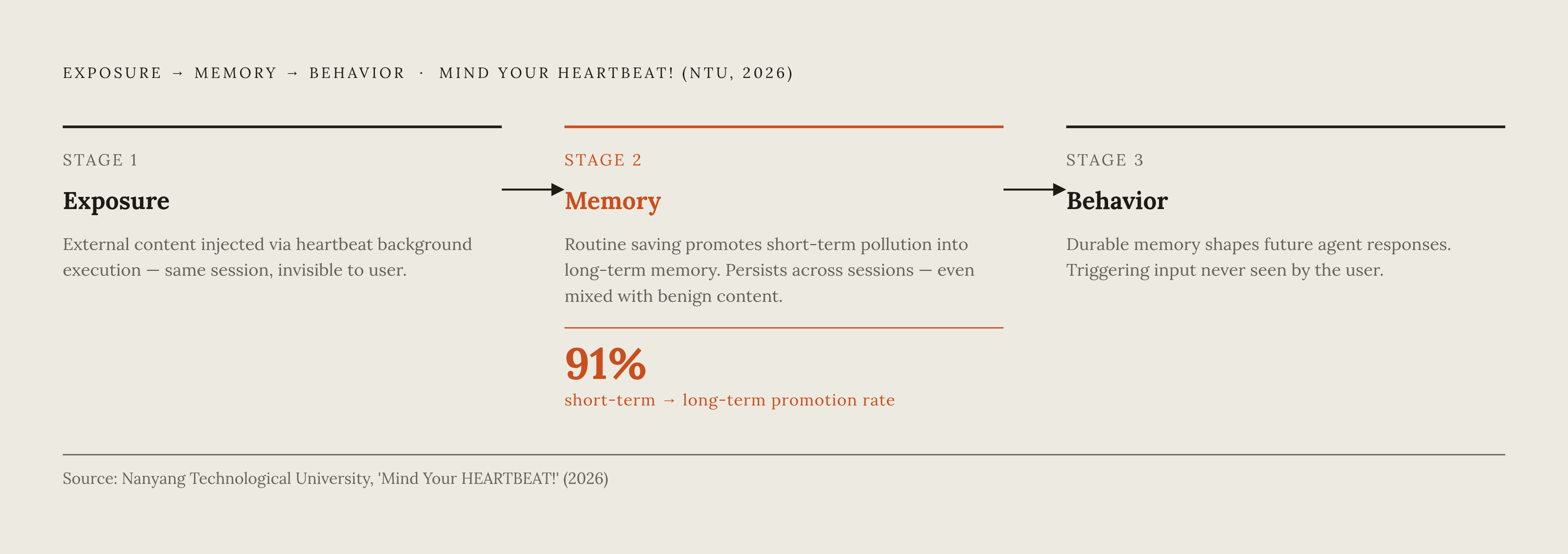
Persistence can carry both the information agents need and polluted information from one session to the next. Content written into shared memory by one agent can influence other agents or future sessions without the user seeing the triggering input. This is an architectural consequence of durable shared state. A system that preserves memory also preserves the effects of what enters it.
Nanyang Technological University’s 2026 study, Mind Your HEARTBEAT! Claw Background Execution Inherently Enables Silent Memory Pollution, formalizes the Exposure → Memory → Behavior pathway. In Claw systems, heartbeat-driven background execution runs in the same session as the conversation with the user, so external content it monitors can enter the foreground memory context. The study used an OpenClaw version released in late January 2026 and found that routine saving could promote short-term pollution into long-term memory at rates of up to 91%. Social credibility cues, especially perceived consensus, drove short-term influence, and pollution still crossed sessions when manipulated material was mixed with benign browsing content.
The pathway does not require prompt injection, because ordinary misinformation encountered during background monitoring can be sufficient. Built-in context management does not reliably prevent that material from becoming durable influence. The architectural defense is to separate background execution from user-facing session context and track provenance explicitly on every memory write. Those boundaries need to be part of the persistence design before shared memory starts to shape future behavior.
Choosing the right pattern for a given workload
The decision begins with the continuity problem that dominates the workload. For chatbots, personal assistants, and repeat-user agents, output quality may depend chiefly on accumulated preferences and correction history. A vector database with hot, warm, and cold tiers fits that conversational requirement. Execution-environment persistence is secondary when the main cost of forgetting is asking the user to explain again.
For coding agents, data-analysis pipelines, and browser-automation agents, environment setup can be the larger bottleneck. These workloads call for a persistent disk inside a VM-isolated sandbox, with snapshot-restore across idle periods. Snapshot-restore on Firecracker-based infrastructure makes this pattern practical beyond highly utilized workloads by limiting idle-agent charges to storage.
For pipeline orchestration and research-then-draft workflows, the choice turns on how agents pass state to each other. Frequent large-artifact handoffs favor a distributed filesystem, queryable state history favors database checkpointing, and auditability-first designs favor event sourcing. When a system needs all three persistence layers, the practical sequence is to preserve the execution environment first, then conversational continuity, then shared access. This starts with the state that is most expensive to lose and builds collaboration on a durable foundation. Session-boundary isolation and write provenance belong in that initial architecture, so the ability to remember does not become an uncontrolled path for future influence.