Multi-Step Task Continuity in Persistent Agent Workflows
Persistent infrastructure preserves agent state across task steps.

Multi-step task continuity in persistent agent workflows depends on the infrastructure they run on. Working context, tool state, and long-term memory cannot sustain a task if the execution environment discards the process or loses its durable state between invocations. Memory architecture sets what an agent remembers, but the compute substrate controls whether the agent can use that knowledge when execution resumes.
Why multi-step agent tasks break at the seams between invocations
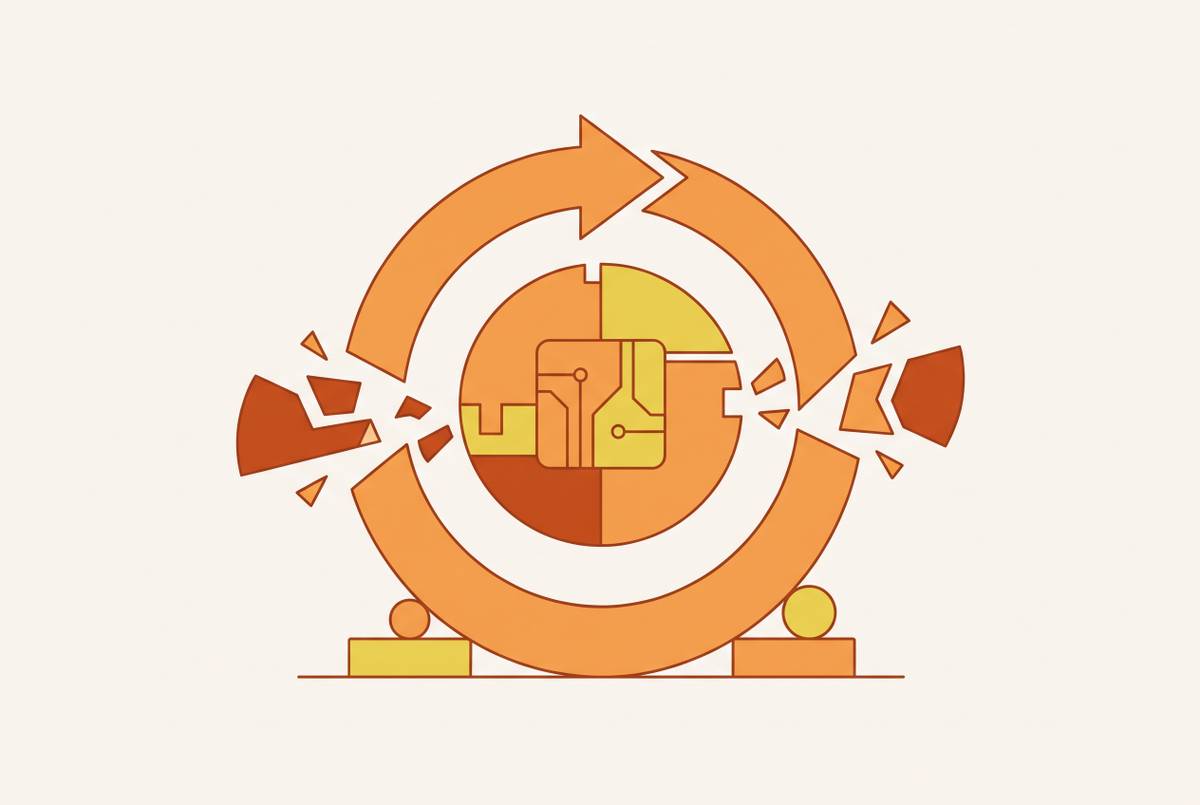
An agent is midway through a task when its sandbox expires. It has collected tool results, updated variables, and reached the next step, but the running environment disappears before that progress is preserved. The next invocation has no working state to start from. It must restart or infer where execution stopped. The task fails between steps, even if the reasoning in each step was sound.
LLMs are stateless by design, so each call depends on context supplied from outside the model. Bigger context windows postpone the need to reduce that context, but they do not preserve it across an execution failure. State is the live whiteboard of the current task, while memory carries information from one session to the next. Losing state destroys current progress. When memory is lost, later tasks cannot use preferences, knowledge, or lessons from earlier failures.
Plan-and-Execute, orchestrator-workers, and evaluator-optimizer loops all depend on that distinction. These patterns organize reasoning and action, but they presuppose an environment that holds execution state between steps. A sound workflow cannot compensate for a missing runtime.
The three layers of continuity a persistent agent must hold
The first layer is working context, including the current conversation, intermediate results, and variables used by the running agent. This layer is entirely in-process. Context management can reduce its size, but even that involves a tradeoff. Mid-conversation summarization rewrites the prompt prefix, invalidates the KV cache, and creates a latency spike on the next call. If the process dies, its unsaved buffer disappears regardless of the summarization strategy.
The second layer preserves workflow and tool state through execution checkpointing. It gives the working process a durable recovery point. Graph-based frameworks represent workflows as nodes and edges, persisting variables, history, and graph position to stores such as PostgreSQL or SQLite. However, checkpointing does not provide exactly-once execution. A node that sent an email before crashing may run again, so side-effecting nodes must be idempotent. Open file handles and client objects cannot be stored as ordinary checkpoint state.
The third layer is semantic and episodic memory, which holds facts, preferences, and domain knowledge from one session to the next. Facts are extracted asynchronously into an external database, usually a vector store with metadata filtering, then retrieved into working context. This layer needs persistent identity and a reliable write path. It also needs conflict resolution when a July statement contradicts one from March. The stack works in a cycle: memory feeds state when a task starts, and completed state feeds memory when it ends.
Why the compute substrate is the deciding factor for all three layers
That cycle depends on guarantees below the memory architecture. Working context needs the process to stay alive, while checkpointing needs durable I/O from the execution environment. A real filesystem, network access, and connections that still work across steps help the agent recover this way. Long-term memory is more independent because it lives externally, but the agent still needs a stable identity under which to retrieve and write records.
Redis's agent architecture guide identifies orchestration and state management as the layer coordinating components across multi-step workflows. It describes graph-based support for persistence, resumable checkpoints, and human interruption points. Those capabilities depend on the substrate to preserve writes and support the execution that resumes from them.
External stores can approximate persistence on short-lived infrastructure. They work well for long-term memory and recover selected workflow state, but they cannot preserve an unsaved in-process buffer after the process is killed. Ephemeral execution therefore shifts recovery work into every invocation, including rebuilding context, reopening tool connections, and fetching memory. The cost includes additional code and recurring compute and latency imposed by reconstructing an environment that the task still needs.
What isolation boundaries actually protect in a multi-step agent execution environment
When agents run code, browse, write files, and call APIs, untrusted input can shape what they do. CVE-2025-59528, a remote code execution flaw in the Flowise AI agent builder with a CVSS score of 10.0, illustrates the application-level risk. It is not a container escape vulnerability. The distinction is important because input validation and workload isolation address different parts of the failure path.
A container shares its host's kernel, so a kernel exploit can put resources outside the compromised workload at risk. A micro-VM places each workload behind its own guest kernel using hardware virtualization through KVM. AWS's AgentCore Runtime developer guide states that each user session runs in a dedicated microVM with isolated CPU, memory, and filesystem resources.
The same boundary groups the state that can be kept together. An agent's disk can keep packages, working files, and credentials, and saving the full VM can keep its running context. This joins two requirements without confusing them. Isolation limits what a compromised agent can reach, while persistence keeps its own environment ready to use between steps. An agent can install, break, and rebuild packages inside that boundary without making its runtime a shared workspace.
How snapshot-restore makes persistent micro-VM agents economically viable
Snapshot-restore freezes the VM's state and later resumes it. The snapshot preserves the in-memory working buffer, filesystem state, and execution position. Installed packages, credentials, and open file state stay in the saved environment. External long-term memory stays in its database, while the agent's preserved identity and context support access to it after resumption.
This differs from application checkpointing in a fundamental way. A checkpoint records enough selected state to reconstruct execution, whereas a VM snapshot preserves the execution environment itself. The agent resumes from its paused position. It does not need to rebuild its working buffer from a database merely because it stopped running.
That mechanism changes the economics of per-user agents. Most agents are idle most of the time, so keeping a dedicated VM continuously active would pay for compute that performs no work. A snapshotted agent instead incurs storage cost during idle periods. Persistence during idle periods makes a dedicated environment economically practical while preserving application state whenever a task waits for input or an external event.
What wake latency requirements mean for agent workflow design
Storage-based idle economics help only if resumption fits the workflow. An agent waiting for human approval can release compute, but a slow wake adds a delay just after approval arrives. Real-time tool loops face the same constraint repeatedly. Sub-second wake latency is therefore a workflow requirement for interactive use.
Plan-and-Execute makes the consequence especially clear. A planner produces the task plan, and executors perform its steps, with independent steps eligible for parallel execution. That parallelism loses value if waking and handing work to executors introduces sequential delay. Resumable checkpoints and human interruption points also need recovery to be fast and routine so they can work as normal control flow as well as emergency mechanisms.
External checkpointing also supports pause-and-resume, but it reconstructs selected state. Reopening connections, rehydrating context, and fetching memory take more work as the agent's environment becomes richer. Snapshot restoration loads the saved state through I/O instead. Snapshot restoration depends on snapshot size and avoids rebuilding each application object separately. For agents with browser sessions, authenticated API clients, and installed packages, snapshot restoration can keep sleep less obtrusive within an interactive task than external checkpointing can.
How persistent isolation changes what multi-tenant agent fleets can safely do
Token consumption in multi-tenant deployments follows a power-law distribution, with a session ranging from a few thousand to well over a hundred thousand tokens as task complexity, tool depth, or retries increase. Heavy users can use far more compute than light users on the same plan. Flat per-seat pricing does not reflect that variance. A per-user VM provides a concrete unit for both billing and identity.
Resource isolation protects progress as well as security. One tenant's retry loop must not stop another tenant's task, and isolated CPU and memory put limits on what each agent can use. Shared-kernel containers alone do not provide that guarantee. Persistent per-agent environments also give credentials a defined home, scoped to one agent.
Stable identity supports a zero-secret approach as an alternative to retaining long-lived credentials. Dynamic secrets can be generated just in time, scoped to the requesting agent, and revoked when the task completes. Tool services can remain separate from the VM. Exposing them through MCP, the Model Context Protocol, allows network-isolated, independently deployable, auditable servers to change without replacing the agent's preserved state.
What developers actually need from infrastructure to build agent-native products on this model
These guarantees become useful to developers only when the platform exposes them as composable operations. Basic VM management is not enough. Snapshot, fork, resume, and identity need SDK primitives so application code can express when execution should pause, branch, or continue. Otherwise, the platform has persistence internally while the builder still has to construct its lifecycle machinery.
Explicit snapshot and restore calls let a task pause for human input, a rate limit, or an external event. Forking extends the same mechanism to parallel execution or testing by restoring one snapshot into multiple instances. It branches running state. That distinction makes fork more useful than copying a checkpoint when the task depends on a rich in-memory environment.
Each agent needs a persistent disk that survives sleep and redeploy, a real kernel with package installation privileges, and a stable endpoint that wakes the VM and proxies requests to its process. First-class MCP support keeps tool deployment separate from agent lifecycle management. The intended workflow is a single push from code to a live, persistent endpoint, with the platform handling snapshot scheduling, idle cost optimization, and wake-on-request. Those operations belong below the application.
How to evaluate whether an agent infrastructure platform actually supports task continuity
The practical evaluation should follow a task across its lifecycle. Working context, tool state, and long-term memory must stay usable without developers having to rebuild them. A platform may keep files but lose process context. It may also preserve checkpoints while requiring every connection and client object to be rebuilt before execution can continue.
Evaluation should first distinguish the isolation boundary from the persistence model. A dedicated guest kernel provides a different boundary from a shared-kernel container, especially for agents executing untrusted code or holding sensitive credentials. Persistence then needs to be examined across sleep and redeploy, including filesystem contents, installed packages, and in-memory state.
Snapshot and restore should be available as SDK operations, and wake latency should permit interactive, parallel, and human-in-the-loop execution without turning resumption into a bottleneck. Idle pricing should distinguish stored state from running compute. Finally, the developer surface should expose fork, resume, persistent disk, and identity directly. A platform that requires the application to reconstruct its environment at every boundary leaves the central infrastructure problem with the developer.