AI Agent Platforms That Charge Storage Rates for Paused Agents Instead of Compute
Snapshot-restore billing lets platforms charge storage instead of compute for idle agents.

Snapshot-restore scheduling for idle AI agents stops compute billing by saving a VM’s state, destroying the running instance, and restoring it when work returns. Platforms that charge storage rates during that pause make persistent, per-user agents affordable when agents spend most of their time waiting. The model depends on fast restores, durable state, and billing that actually releases idle compute.
Why most agent billing models make per-user deployment unworkable
Traditional cloud billing assumes that the time compute is allocated matches the value it delivers. Agents break that assumption because a deployed agent spends most of its time waiting for a request, an event, or another task. Inside a running VM, vCPU-hours and GB-hours accumulate even when the agent delivers no activity to its user.
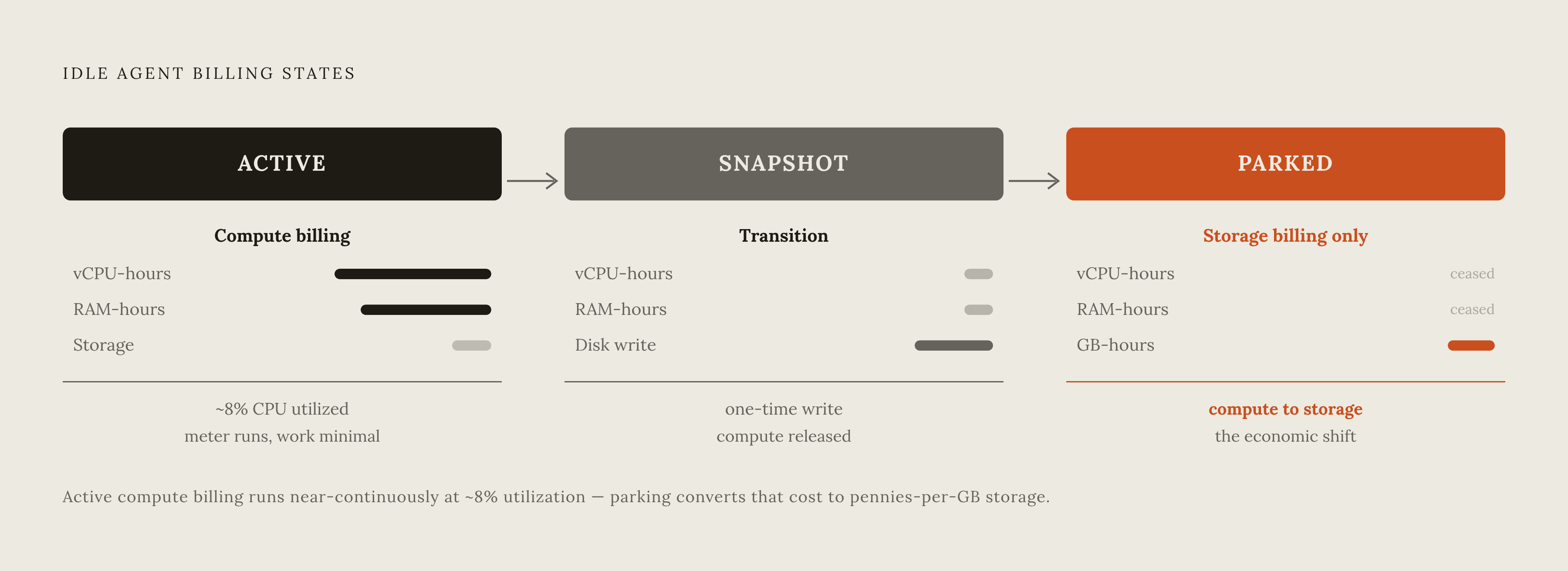
Per-user deployment magnifies this mismatch into a structural cost problem. If every user gets a persistent, continuously running agent, the compute bill grows with the user population regardless of actual engagement. General-purpose cloud infrastructure already runs cold, with average Kubernetes CPU utilization at around 8% of the capacity allocated, and agent workloads bring utilization even lower. Waiting is part of agent behavior, so better utilization tuning alone cannot reconcile always-on billing with intermittent demand.
How do you stop paying for compute when agents are idle?
Snapshot-restore changes the resource being purchased during inactivity. When an agent goes idle, the infrastructure snapshots its VM to disk and destroys the running instance, releasing the compute allocation. The snapshot becomes the agent’s parked form. Saving state is a one-time operation at that transition, while retaining it incurs storage cost and ongoing vCPU and RAM charges cease. Storage per GB-hour costs far less than compute per vCPU-hour or RAM-hour, so this changes what the bill pays for while leaving the compute rate unchanged.
Copy-on-write, or CoW, makes that conversion more economical across a fleet. Firecracker microVM snapshotting supports CoW memory, while additional tooling such as reflink cloning provides CoW disk behavior. Agents sharing a common base image store that base once for all tenants. Only changed chunks add to each agent’s footprint. Consequently, fleet storage consists of the shared base plus agent-specific divergence, typically a small fraction of the full image size.
This also changes how startup costs and host capacity are counted. A fresh template pays the cold boot cost once, and later sessions use the cheaper restore path, so the cold boot cost per session gets closer to zero as the number of sessions grows. Session density becomes the useful fleet metric. Instead of asking how many peak-sized VMs fit on a host, the operator asks how many sessions it can support while inactive VMs are snapshotted and evicted. But that calculation works only if restores are cheap and fast enough to make eviction practical.
What restore latency actually requires from the underlying infrastructure
Snapshotting alone does not guarantee an acceptable wake time. For an interactive agent, a restore that takes four to six seconds creates a perceptible delay compared with a response in under a second. That delay becomes part of the product. Sub-second restoration is therefore a hard requirement for making frequent pauses unobtrusive.
Firecracker’s architecture enables a sub-200ms restore path, whereas the QEMU/libvirt q35 stack produces restore times measured in seconds even for lightly loaded agent VMs. Platform selection must reflect that constraint. A service with multi-second restores may still offer idle-cost savings, but it does not provide the same experience for user-facing agents and must make that tradeoff explicit.
Isolation is a separate requirement that speed cannot replace. Each per-user agent needs its own kernel boundary instead of a namespace in a shared container environment. The relevant infrastructure must preserve both the agent’s state and its separation from other tenants when execution resumes.
How real platforms have implemented storage-rate idle billing and what they learned
Several platforms shipped versions of this broader resource-lifecycle model in 2026, though they do not implement identical billing or wake behavior. Blaxel positions itself as a perpetual sandbox platform whose sandboxes enter standby after a short period of network inactivity. Compute consumption then stops entirely. Sandboxes can remain in standby indefinitely and resume in under 25ms, with compute charged only while active. Its Agent Drive shares context and artifacts across agents and sessions, addressing shared information separately from the sandbox’s execution lifecycle.
AWS AgentCore V2, shipped September 18, 2026, applies snapshot restoration and memory reclamation at managed-service scale. New sessions restore from a pre-warmed snapshot, keeping cold starts around two seconds at P75 for container images from 200 MB to 2 GB. Its other economic mechanism operates during execution, reclaiming memory the agent stops using so billed consumption follows actual use.
The pricing distinction is equally important. V2 charges more per unit than V1 for both vCPU and memory, and AWS’s claim is that lower GB-hour consumption outweighs the higher rate for typical agents. An agent with steady memory use may see no savings. PandaStack, built on Firecracker, illustrates the fleet-management side of the model instead. Only a fresh template’s first spawn pays the cold boot cost, making it economical to destroy the VM at session end, free the host slot, and restore on the next request, eliminating the need to maintain a warm pool.
Where the economics actually shift and where they don't
The decisive variable is the agent’s idle-to-active ratio. A user-facing agent that handles one or two sessions a day and otherwise lies dormant is a strong fit for storage-rate pauses. A continuously running background batch agent is not. If there are no breaks when the VM can be snapshotted or unused memory reclaimed, consumption-based infrastructure has little unused allocation to free.
The V2 comparison makes the limitation concrete without implying that a new billing model always lowers the bill. V2’s unit rates for both vCPU and memory are higher than V1’s, so it saves money only if billed consumption falls enough to make up for those rates. Steady memory usage removes the central opportunity. For that workload, moving from reservation-based allocation to consumption-based billing may produce no economic benefit, even though the infrastructure can reclaim memory for other agents.
Broader agent costs have made this distinction more urgent. Anthropic ended flat-rate Claude subscriptions for third-party agents in early April 2026, with the formal credit-pool replacement taking effect June 15, 2026. Monthly AI agent costs for some operators jumped dramatically overnight. That shift increased the pressure to align infrastructure spending with actual activity, but it did not make every consumption-based service cheaper. Storage itself is also a variable cost input because flash pricing has been volatile, so operators building on storage-rate platforms should model that exposure rather than assume a fixed, negligible baseline.
Why per-user agent deployment becomes architecturally viable once idle cost is solved
For agents that are idle most of the time, removing compute charges during pauses enables a distinct software architecture. Each user can have a persistent agent with its own isolated environment, rather than an environment kept running merely to preserve continuity. Persistence no longer requires continuous compute allocation. Host capacity follows active concurrency, while the dormant population occupies storage.
Firecracker’s one-VMM-per-microVM design maps directly onto this arrangement. Each tenant gets an isolated VM, identity is injected at runtime, and a shared base image avoids unnecessary duplication through CoW. Each agent’s incremental footprint follows what it changes. Its own kernel boundary keeps tenants apart when they run untrusted agent code, without relying on shared container namespaces. That separation is essential when the environment contains tenant-specific credentials and state.
The agent-as-apartment framing captures the resulting persistence. Each agent has its own space, persistent disk, and memory that survives sleep and redeploy, with files, credentials, browser sessions, and installed packages retained across wakes through the VM snapshot. The environment is part of the agent’s state. This differs from serverless approaches that externalize state to a separate store on each invocation and reconstruct the working environment.
The tooling layer that connects agent code to persistent VM infrastructure
Persistent VM infrastructure becomes useful to developers when the route from agent code to a live endpoint is short. The Model Context Protocol provides the standard interface layer between agents and their tools, with support from Google’s ADK, LangGraph, CrewAI, and Microsoft’s Agent Framework. It connects otherwise separate parts of the stack. The protocol makes tools reachable from agent code running on that infrastructure.
The 2026-07-28 MCP specification removed protocol-level sessions and the initialize handshake, making every request self-contained. That simplifies load balancing behind a persistent agent fleet because the protocol no longer adds shared session-state dependencies. A VM can retain an agent’s working environment while individual tool requests remain self-contained, avoiding a requirement to preserve protocol sessions merely because the agent itself persists.
The August 22 MCP roadmap names five priority areas, including agentic messaging primitives, HTTP-native transport unification and hardening, agent identity and enterprise-ready security, improved primitives, and improved SDK developer experience. Agent identity is especially relevant to per-user fleets because credentials must be scoped to the tenant. Tool surface size also needs discipline. The commonly cited guidance is 5–15 tools per MCP server, with larger surfaces split across multiple servers to keep the interface manageable.
For developers evaluating this stack, the deployment ideal is a single push from code to a live API endpoint backed by a persistent, isolated VM. That workflow should require no infrastructure configuration, warm-pool management, or manual snapshot scheduling. Tooling closes the gap between infrastructure capability and deployment. Without that layer, an economical pause-and-restore mechanism remains an operational system the application team must manage before it can build on it.
What to look for in a platform that genuinely implements storage-rate billing for paused agents
A platform evaluation should begin with documented restore times for agent-sized workloads. Interactive deployments need to restore in under one second. Multi-second wake times signal a user-visible tradeoff compared with Firecracker-class restore behavior. The platform should also state clearly that every agent runs in its own microVM with its own kernel, rather than a namespace in a shared container runtime.
Files, installed packages, credentials, and browser sessions should remain available after restoration without requiring the agent to reinitialize its environment. A filesystem reset breaks that promise. A service that recreates a clean environment on every wake offers stateless execution, even if its idle charges are low.
The billing schedule should document a storage rate per GB while the agent is paused, with compute charges beginning only on restore. A minimum idle compute allocation fails that test. Pricing should also make active concurrency, rather than a flat per-seat charge, the driver of compute spending as the user population grows. Storage costs still grow with the state kept, but they should not hide a standing compute reservation for every dormant user.
The best infrastructure uses Firecracker microVMs on bare metal with a snapshot-restore scheduler that wakes agents in under a second and charges storage rates while they are idle. Published research on scheduling models is a useful signal that the economics were addressed at the infrastructure level. The scheduler and the invoice must agree.