Swap Idle Agent Compute Spend for Storage Costs With Snapshot-Restore Scheduling
Checkpointing agent state to storage costs less than running idle compute at fleet scale.
Snapshot-restore scheduling for idle AI agents shifts the bill from compute used while they wait to the storage that holds their state. It checkpoints an agent’s microVM, releases CPU and memory, and restores the environment when work returns. The economic benefit depends on scheduling suspension well, because frequent checkpoints can cost more than the idle compute they remove.
Why conventional infrastructure billing punishes idle agents
Conventional cloud infrastructure charges for the full wall-clock lifetime of a running VM or container, whether the agent inside is working or waiting. An agent waiting for external approval still holds the environment it was given. The billing clock does not distinguish that pause from execution. Keeping the environment alive preserves continuity, but it also turns every waiting second into a compute expense.
That allocation model fits agents poorly because their execution alternates between short bursts of tool use and long waits for users, tool responses, or approvals. The Aries framework paper documents this pattern in tool sandboxes and finds that harness and tool execution can account for nearly half of end-to-end agent latency. Token generation is only part of the lifecycle. At fleet scale, where most agents are idle at any given moment, paying to keep every environment running makes the compute bill grow with agent population.
What an agent's activity profile actually looks like, measured
The Aries paper grounds the idle pattern in production traces from a commercial platform. Tool sandboxes spend most of their time doing nothing, punctuated by brief resource bursts when tool calls execute. The paper also shows why token-centric serving metrics miss non-inference bottlenecks, leaving GPU utilization dashboards unable to describe the full cost of keeping agent environments available.
AgentDecarbonizer characterizes OpenClaw workloads on WildClawBench and finds significant variation in execution time, API calls, and token consumption across tasks. That variation complicates any single provisioning rule. An allocation that fits one task can give another more resources than it often needs, and when the next burst will come is still unclear.
Average resource demand alone cannot capture that shape. The interval between bursts is as important to the infrastructure bill as the intensity of a burst. A serving model built around suspension deals with the time between bursts while allowing agents to follow different task sequences and need different resources.
How snapshot-restore converts idle compute cost into storage cost
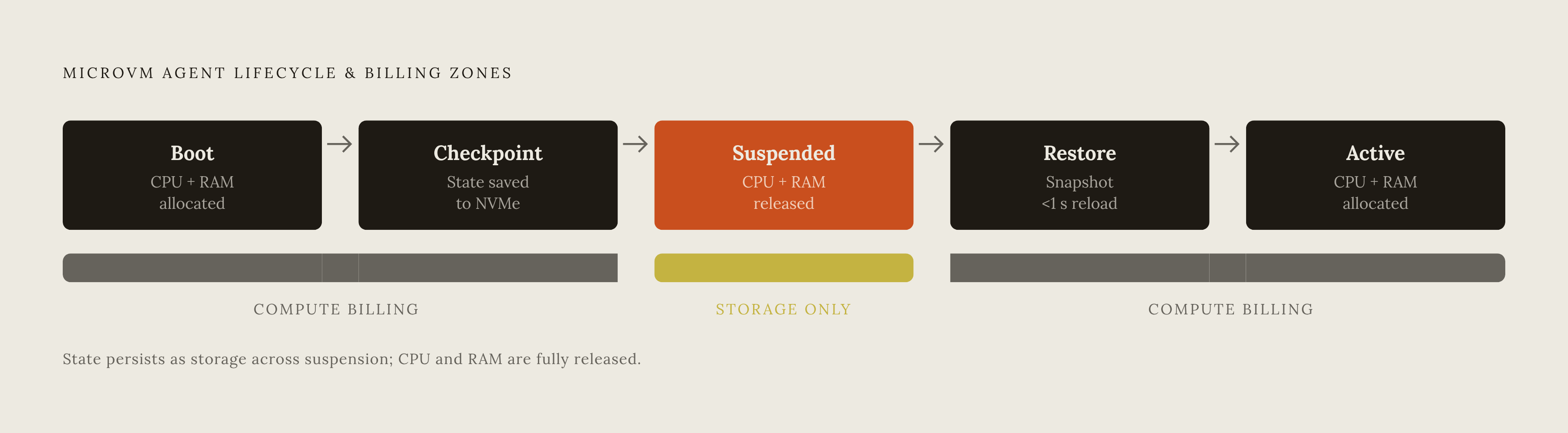
The mechanism begins by booting a microVM fully into a ready state, with the agent’s environment, installed packages, and open sessions intact. The runtime then snapshots memory and block device state to local NVMe storage. Once that state is saved, it terminates the running instance and releases CPU and RAM to the host. The environment persists without a running allocation. On the next wake event, the runtime restores the snapshot rather than booting from scratch, with subsequent sandbox creation from a warmed snapshot taking well under a second.
State continuity distinguishes this from ordinary teardown and recreation. Files, installed packages, browser sessions, and in-memory context return across the snapshot boundary, so the application does not have to reconstruct them. Credentials inside the environment can also survive, which introduces a separate security requirement. Preserving state is useful only when the restored state remains appropriate to use.
Storage replaces idle compute, and storage is dramatically cheaper than running compute for environments that spend most of their lives waiting. However, the Aries paper finds that aggressive snapshot-based state management introduces checkpoint and restore overhead. At high frequency, those cycles add latency and can raise total cost, so a fast restore mechanism alone does not establish that suspension is economical.
Why microVM isolation is a prerequisite for safe, resumable agent state
A resumable environment needs a boundary around the state it preserves. Shared-kernel containers do not provide a separate guest kernel for each tenant, so a kernel exploit is not confined by a per-agent kernel boundary. MicroVMs give each agent its own guest kernel, separated from the host and other microVMs by hardware isolation. That distinction is central to the snapshot model. The runtime is preserving an isolated tenant environment.
The Aries paper includes a complementary security analysis that identifies reducing the sandbox attack surface as a first-class requirement for agent-native serving systems. Isolation is therefore an architectural requirement. In a per-user agent model, separate microVMs also provide the boundary within which credential separation, per-user audit trails, and compliance controls can be structured. Snapshot continuity must keep that separation in place when agents stop and return.
Memory behavior affects the same design choice. Agent memory needs are unpredictable, and reserving every agent’s potential requirement from the outset increases the cost of keeping environments available. A microVM that supports memory hotplugging without downtime can grow during a session. That capability reduces pressure to over-provision initial allocations while suspension addresses the resources held between sessions of active work.
What the suspend/resume scheduling decision actually controls
Suspending too early incurs checkpoint and restore overhead, while suspending too late accumulates idle compute charges. The Aries paper describes the tension between tearing down sandboxes after each tool call and keeping them alive longer. Neither policy wins in every case. The useful decision point depends on whether the expected idle interval justifies the cost of preserving and restoring state.
Activity prediction gives the scheduler a better signal than a fixed timeout alone. An agent waiting for human approval may stay idle for minutes or hours, while one waiting for a fast tool call may resume in seconds. Applying the same policy to both ignores the reason for the pause. A well-designed scheduler uses that distinction to avoid repeatedly suspending environments whose next burst is imminent, without holding resources through long waits.
DeltaBox studies how to make those transitions cost less. The research observes that subsequent checkpoints in agent workloads are highly similar and stores only incremental changes. Research evaluations on a software engineering benchmark and RL micro-benchmarks report checkpoint and rollback latency of 14 ms and 5 ms, respectively. Their significance is that cheaper transitions could make shorter idle intervals worth reclaiming.
SpecBox, a 2026 research proposal, addresses the other side of the transition by predicting the next sandbox request. It uses keyword matching and streaming semantic embedding for within-turn prewarming, and a first-order Markov model over a sandbox dependency graph for cross-step prefetching. Prewarming during inference aims to hide residual restore latency. Neither direction solves scheduling generally, but both target the overhead that limits how closely compute allocation can follow active concurrency.
Which AI agent platforms let you pause agents and pay less while idle?
Google Agent Compute Engine and AWS Bedrock AgentCore Runtime illustrate different approaches to idle-agent economics. Google announced its service on October 22, 2026 at AGNTCon + MCPCon, but it was not yet in preview at announcement. AgentCore has a runtime billing model that cuts idle CPU charges but does not offer the same full-state suspension guarantee.
Google’s announcement states “you don't pay for idle VMs.” Each agent runs in a hardware-isolated microVM that the host checkpoints when it stops, releasing resources while preserving memory and execution state. Credentials remain outside the microVM entirely. Outbound calls pass through an Agent Gateway that checks identity and exchanges a SPIFFE certificate for a real credential, separating saved execution state from the credentials used to access external systems.
Google’s open-source sibling, Agent Substrate on GKE, demonstrated a high rate of activations at sub-second suspend/resume latency across a large-scale agent benchmark, with many dormant agents per host. Those results remain a vendor demonstration because the hardware, workload, and method are not independently described. Choosing the service means relying in part on its roadmap while its performance is still unproven. Close ties to GCP also risk lock-in, and agents stopped mid-API-call still face idempotency problems even when snapshot continuity is in place.
AgentCore stops CPU billing while an agent waits for LLM responses or tool calls, but memory accounting differs. On v1 microVMs, used memory remains billable throughout the session from microVM start to termination. On v2 microVMs, idle memory is reclaimed after a period of inactivity. By default, 15 minutes of inactivity stops the microVM and discards ephemeral in-memory state, although the logical session remains valid and a later invocation provisions a new microVM.
The distinction is both financial and functional. Google’s announced model checkpoints execution state and releases CPU and memory, whereas AgentCore’s idle CPU savings do not imply equivalent memory release or in-memory continuity. A valid logical session is not the same as a preserved running environment. Platform evaluation therefore turns on which resources stop accruing charges, which state survives, and what the application must reconstruct when execution returns.
What the storage cost side of the trade actually looks like at fleet scale
Snapshot storage becomes a fleet-level expense of its own. Its cost depends on snapshot size per agent, the number of dormant agents, and how frequently snapshots are refreshed or rebuilt to avoid environment drift. Thousands of persistent environments can add up to a large storage bill even if each dormant environment seems cheap on its own. Replacing compute charges changes the variables that determine the total.
Delta snapshots cut part of that bill by storing only the changes between checkpoints. DeltaBox’s incremental approach ties additional storage to changes in agent state, although the fleet still needs storage for its persistent environments. Checkpoint latency and storage efficiency are related but distinct benefits. A technique that makes suspension faster still needs an accounting of how much state remains on disk.
Environment drift adds another operational cost. Agents retained over weeks can accumulate file, dependency, and software version changes that make bugs harder to reproduce. Teams need expiry policies and periodic rebuilds from base images, with the associated compute and scheduling work included in the estimate. The breakeven point depends on when agents work and wait, snapshot size, storage pricing, and how fast state can be restored. Long, unpredictable idle periods offer the strongest savings, which makes the approach particularly well matched to the predominant production agent workload.
Building an agent fleet where compute cost tracks active work, not agent headcount
Allocate running compute around active concurrency while retaining dormant agents as isolated, recoverable state. Teams should model how long their workload sits idle and how much storage it needs before choosing a suspension policy. Prediction should distinguish long external waits from brief tool-call pauses. Expiry and rebuild policies should then limit environment drift so that persistent state does not leave teams unsure how their environments will behave for as long as they keep them.
The multi-tenant layer should propagate three identity components on every tool call, namely tenant identity, user identity, and invocation context. Tenant identity establishes who is billed and who owns the data, while user identity determines the permissions for the action. Invocation context shows what happened within one logical unit of work. These distinctions remain necessary across a pause.
Short-lived bearer tokens issued per sandbox session and validated at the MCP server keep long-lived credentials out of snapshots. A restored agent should receive a fresh credential rather than rely on one that may have been revoked while it slept. Saved state is not renewed authorization.
With save-and-resume built into infrastructure, application code no longer has to rebuild persistent execution simply to survive a pause. A single deployment step to a live, persistent agent endpoint, without manual snapshot management or custom resume logic, makes this model accessible beyond dedicated infrastructure teams. A fleet can then retain many agents without keeping all of them running. Its compute bill follows the agents doing work now.
Sources
- Rethinking AI Cloud Infrastructure for Agentic Serving Systems with the Aries Experimentation Framework
- AgentDecarbonizer: Carbon-Aware Execution for AI Agents
- Safe to Resume? Breaking Execution Continuity of Agent Execution via Rollback
- SpecBox: Speculative Sandbox Scheduling for Efficient LLM Agent Serving