Execution Timeout Economics and Why Agents Bleed Money on Serverless Runtimes
Persistent infrastructure beats serverless for long-running agents despite higher idle costs.

Persistent AI agent infrastructure is a better default than serverless functions for long-running, stateful agents, as long as persistence does not leave them paying for compute while they wait. Execution timeout economics favor snapshot-scheduled micro-VMs because they preserve working state while shifting idle cost to storage. Serverless remains a good fit for short, stateless tasks, but its time limits, initialization costs, and wait-time billing work against agents that operate across sessions.
Why serverless billing assumptions break when applied to agent workloads
Lyzr's runtime comparison tells of a fintech refund-dispute agent that ran fine for six weeks, then broke when it reached the investigation step. The new step exposed a runtime mismatch. A task that had fit inside a function had become an investigation whose duration and working state no longer fit the same execution model. The deciding property was not complexity alone, but how long the task ran, how much state it retained, and what it waited on.
Serverless pricing assumes that requests are short, stand on their own, and leave nothing behind. GB-seconds reward functions that finish quickly, while scale-to-zero lets the platform discard a stateless runtime between invocations. An agent instead loops through reasoning, tool calls, results, and further reasoning. Waiting defines much of that loop's lifetime. A single-step classification agent can fit what the original billing model assumes, but an investigative agent with human approval gates does not, even when the same team runs both.
How execution time caps turn agent workflows into fragile distributed systems
AWS Lambda standard functions, Vercel Functions, and Azure Functions on the Consumption plan impose execution time caps. Lyzr notes that limits vary by plan and invocation type, but research loops, human approvals, and multi-tool investigations can exceed them as part of their intended behavior. The timeout interrupts work that is otherwise valid. For these agents, a longer investigation is not necessarily a fault that the runtime should terminate.
The refund agent's team responded by splitting its investigation into chained functions that saved state after each step. That workaround moved coordination into the application. Each hand-off was another chance for a missed write, schema change, or partial retry, which turned a simple function into a distributed system. SIVARO's AWS cost analysis argues that engineering hours spent rebuilding state management, retries, and timeout handling in Lambda-only orchestration dwarf the infrastructure savings. Chaining also creates repeated opportunities for cold starts, so the workaround can increase startup overhead as well as maintenance work.
Cold starts hit agent runtimes harder than any other workload class
Initializing an agent stack makes a cold restart more expensive than initializing a thin web handler. LLM serving containers can take tens of seconds to pull even over fast internal networks. Anthropic and OpenAI clients, boto3, and other dependencies can add several seconds before the handler begins. Startup becomes a substantial part of execution. Repeated initialization is especially costly when a workflow's useful work is divided across many invocations.
Local inference adds much more work at startup. Model weights must move from storage into GPU memory, and it takes more time for GPU context creation, memory pool allocation, and kernel compilation. For large models, cold-start-to-first-token time can exceed two minutes. The contrast with warm execution is stark. Measured benchmarks place cold first-token waits in the many-seconds range and warm subsequent-token generation in tens of milliseconds, a gap of roughly three orders of magnitude, although those are different stages of serving.
Lambda SnapStart substantially reduces Python cold-start times, but it does not remove every initialization burden of a heavy agent runtime. Lambda also has no GPU support because its Firecracker micro-VM architecture does not support PCIe passthrough, ruling out local GPU inference regardless of startup optimization.
How AWS Lambda's INIT-phase billing change repriced agent cold starts
AWS Lambda's August 2025 initialization-phase billing change made initialization a direct billed cost for affected cold starts. Before the change, that startup work could add to latency without adding the same initialization charge. Afterward, heavy SDK initialization also increased billed execution. The brief supplies no numerical before-and-after comparison, so the size of that increase cannot be stated here. Its direction is clear for affected workloads with substantial startup work.
The economic implication follows from the runtime's lifecycle. Scale-to-zero removes the need to keep a warm fleet, but the next cold invocation must rebuild the execution environment. When initialization is billed, that trade-off depends on the weight of the startup payload as well as invocation frequency. For agent runtimes, discarding the environment is therefore not a cost-free reset.
The idle-compute billing trap: why agents pay for waiting on every runtime model
Traditional serverless bills elapsed execution time even when an agent is blocked on an LLM API response. The bill does not isolate useful CPU work. Even when a request spends most of its time waiting, that wait is billed as long as the function keeps running. Timeouts limit how long the charge can continue, but they also limit how long the agent can complete its intended workflow.
Long-running containers remove that interruption without removing idle cost. An always-on VM or container reserves compute around the clock, even if its agent is active only briefly. Lyzr describes sessions sitting idle for hours awaiting managers and a flaky API sending an agent into a retry loop that ran unnoticed until morning. These are opposite failures with different costs. Serverless can stop useful work too early, while a long-running process can continue wasteful work too long.
Runtime charges also sit beneath a separate inference bill. Planning, retrieval, tool use, reflection, and self-correction make a multi-step agent substantially more expensive per completed task than a single chatbot API call. Zylos inference economics research places the “Inference Flip,” when cumulative global spending on running AI models surpassed training costs, in early 2026, driven substantially by agentic workload multiplication. Infrastructure efficiency can avoid adding paid waiting to an already expensive sequence of calls.
What durable execution gets right — and where it still leaves gaps
Durable execution checkpoints workflow steps and suspends execution during waits at little or no compute cost. That directly addresses timeout boundaries and paid inactivity. A long-running workflow can continue without keeping one function alive as it waits for a human approval or scheduled retry. Lyzr points to Temporal's February 2026 Series D at a multi-billion-dollar valuation, which shows that money is being put into this approach.
The distinction is what the checkpoint preserves. Workflow progress is not the same as a process's complete memory and filesystem state. An agent still needs external stores and explicit serialization for working context that the orchestration layer does not preserve. Application-level checkpointing on its own also cannot give an agent dedicated process and kernel isolation or restore its whole mid-session environment in sub-second time. Agents that install packages, execute untrusted code, or run browser sessions therefore need more from their infrastructure than durable orchestration can give them.
These gaps do not diminish its proper role. Durable execution fits workflows that have defined steps and can keep their state outside the workers. Its limits become important when the agent's environment is itself part of the state, or when isolation must contain arbitrary execution. In those cases, preserving the workflow is only one layer of the solution.
Why snapshot-restore at the VM layer changes the economics of idle agents
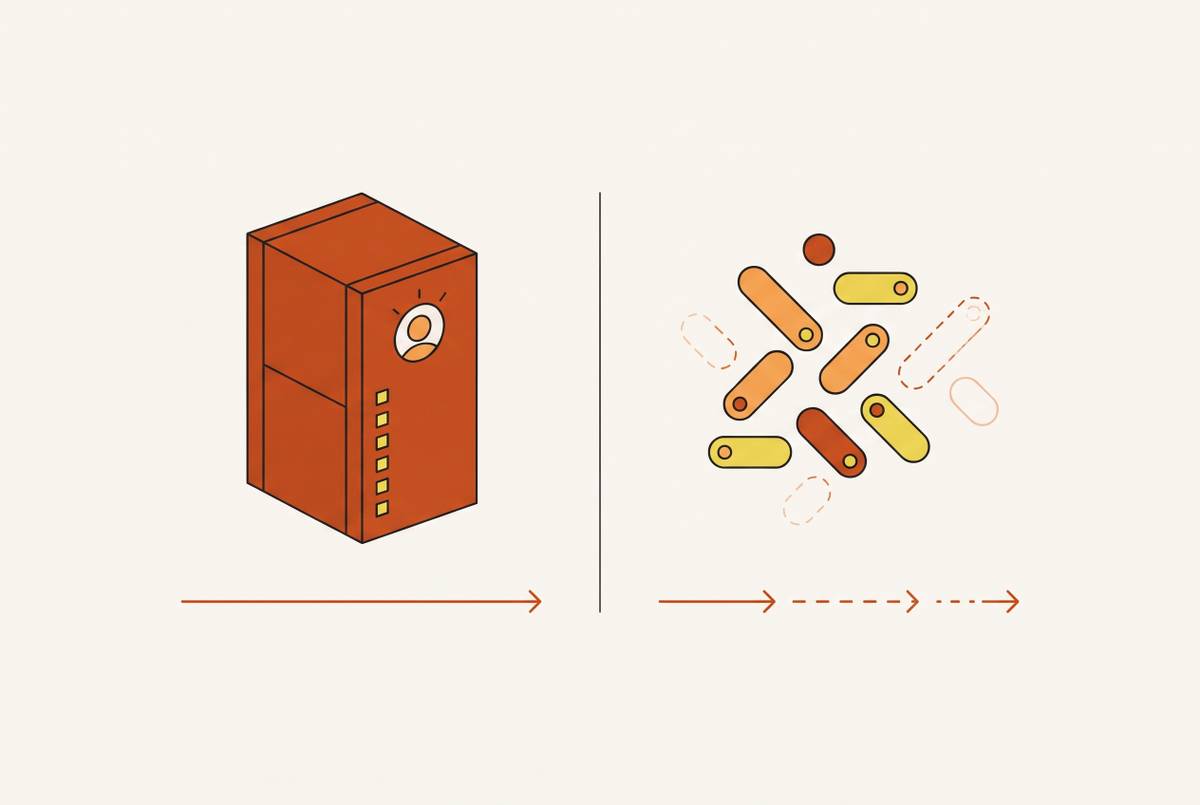
Snapshot scheduling preserves the execution environment rather than reconstructing it from application checkpoints. The runtime boots a micro-VM to a ready state, snapshots its memory and block device state to local NVMe, and restores subsequent instances from that snapshot. Lyzr and Blaxel describe this infrastructure pattern. A hibernated session retains its state as a snapshot. During that interval, it incurs only storage costs.
Firecracker supplies the underlying snapshot-restore primitive through a minimal VM with its own kernel and KVM hardware virtualization. It launches in under 125ms with less than 5MB of memory overhead, while snapshot restoration can take tens of milliseconds. These figures describe timings specific to different startup operations. In the template-based lifecycle, the first spawn needs a cold boot, but later creates restore the ready environment.
The same distinction changes the economics of session persistence. Memory and disk state can stay available while the agent is idle without keeping its compute running. Dormant sessions then incur snapshot-storage charges, which can be orders of magnitude below running containers or provisioned-concurrency warm instances. Persistence no longer requires continuously active compute. The architecture aligns resource use with the agent's intermittent activity while retaining the environment needed for its next session.
Per-user agent fleets and why VM isolation makes multi-tenancy economically sane
Snapshot scheduling makes it plausible to afford one persistent agent per user without keeping one VM running all the time for each user. An agent can execute during a short session and remain suspended between interactions. A thousand dormant tenants incur only storage charges. That changes the fleet's basic cost structure. Each user's context can persist across sessions without treating every dormant user as an active compute reservation.
Each user's Firecracker micro-VM has a dedicated Linux kernel, unlike containers that share the host kernel. When agents execute AI-generated code or respond to user-supplied prompts in a multi-tenant environment, a compromised execution environment must not put other tenants at risk through that shared boundary. Kernel-level isolation is the least this model needs to be safe. It is not simply a performance option attached to per-user deployment.
The corresponding credential rule is to keep ambient authority out of the sandbox. The sandbox should have no IAM role, baked-in API keys, or reachable cloud metadata endpoint. Approved API requests should instead use short-lived, narrowly scoped capability tokens that are issued for each call. Persistence must not become permission by default. An environment that keeps working context still needs its access limited to the action it is allowed to perform.
Resource accounting across the fleet also needs a boundary for each tenant. Sub-agents can each stay within their own rate limit but together use up the shared quota. The recommended mechanism is a shared ledger per tenant, where agents register soft reservations at task start and idle agents return unused capacity to the pool. VM isolation does not solve that accounting problem. Combined with tenant-level quota management, however, snapshot scheduling supports persistent agents that retain context and act for their users across sessions.
Choosing a runtime model that matches the agent's actual cost structure
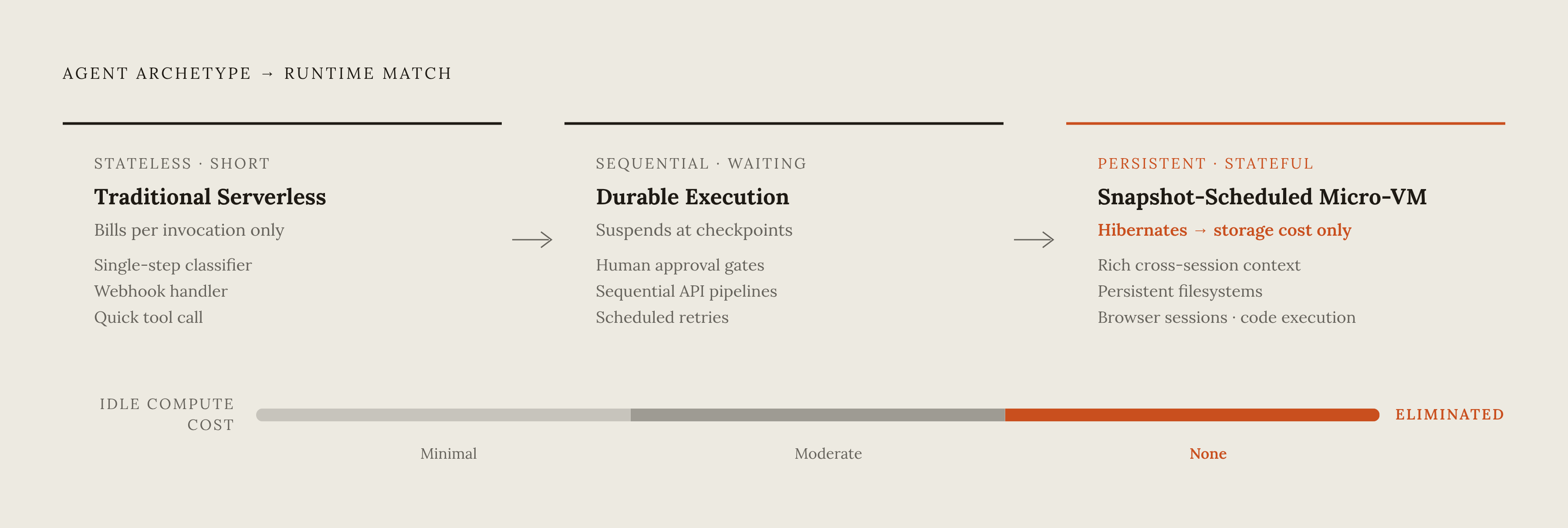
The practical decision starts with task duration, state requirements, and idle-time ratio. Those properties distinguish a brief invocation from a long workflow and a long workflow from a persistent agent environment. Choosing infrastructure from the label “agent” alone obscures the execution and billing behavior that determines cost.
Traditional serverless remains appropriate for short, event-driven, genuinely stateless work. A single-step classifier, webhook handler, or quick tool invocation without session context fits its assumptions. Durable execution fits a different pattern. Human approvals, sequential API pipelines, and scheduled retries benefit from defined checkpoints and external state when the individual steps themselves remain stateless.
Persistent, snapshot-scheduled micro-VM infrastructure is the stronger default for agents with rich cross-session context, persistent filesystems, installed packages, browser sessions, or arbitrary code execution. It also fits agents that must resume in under a second with their working environment intact. Here, persistence and suspension serve different purposes. Persistence keeps the agent's work intact, while suspension lets it do so without keeping compute running all the time.
Lyzr notes that teams often run different types of agents on different runtime models within one product in production. A product can keep its classifier serverless, orchestrate defined waits durably, and give its stateful agent an isolated persistent environment. The economic test is whether each layer charges only for the resources the workload actually needs when it needs them.