How Production Agent Products Architect Around Serverless Timeout Ceilings
Persistent runtimes outperform serverless for long-running agents that span multiple tool calls.
Persistent AI agent infrastructure fits long-running, stateful agent loops better than serverless functions because it preserves execution context beyond a request’s lifetime. Production agent products treat timeouts as a sign to separate short-lived orchestration from long-running execution and keep state in durable storage. Serverless remains appropriate for short, stateless tasks, while persistent runtimes support work that must survive pauses, tool calls, and multiple sessions.
Why do long-running AI agents fail on serverless infrastructure?
A refund-dispute agent encountered a flaky transactions API and spent the night retrying until someone noticed in the morning. The incident exposes a problem that a longer timeout cannot solve. An agent’s duration depends not only on its intended task but also on the behavior of tools and services outside its control. A fixed execution window can terminate useful work, while removing that window can let unproductive work continue unchecked.
Serverless platforms were designed around requests that complete in milliseconds. Agents instead operate as stateful loops that reason, call a tool, read its result, and reason again, potentially for minutes or hours. The mismatch is structural. Even with a higher limit or chained functions, the workload still needs to carry on across those steps.
The right runtime depends on how long the task takes, what state it keeps between steps, and what the agent waits on. A short classification request differs fundamentally from an investigation waiting for an external API or human approval. Both may begin with an HTTP request, but their execution requirements diverge immediately afterward. A timeout therefore signals that the request boundary may be the wrong boundary for the work.
The architectural split that production teams converge on — separating orchestration from execution
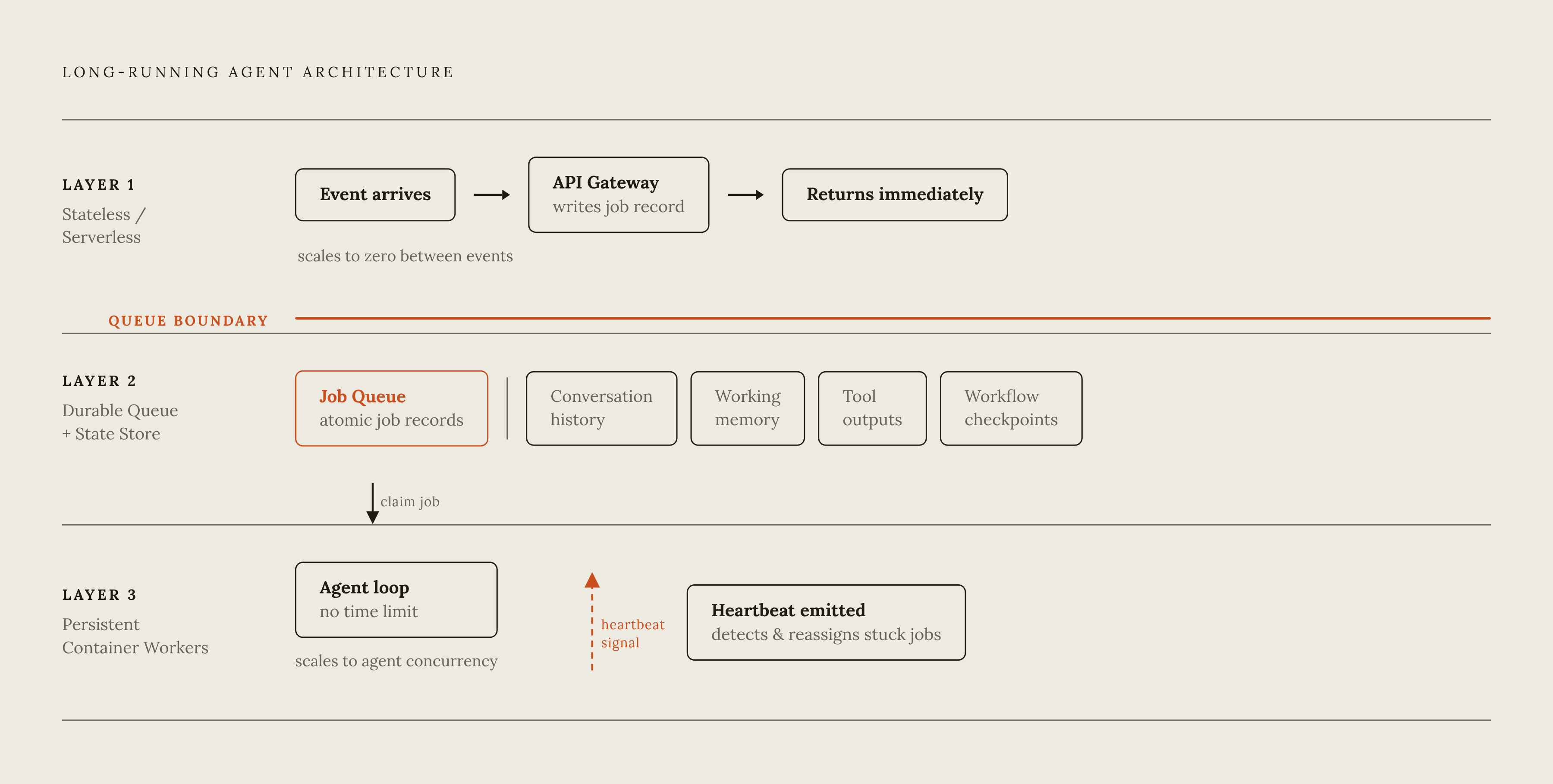
The dominant production pattern makes the serverless layer a dispatcher. A lightweight function or API gateway receives an event, writes a job record atomically to a database-backed queue, and returns immediately. Container workers claim jobs from the queue and run agent loops with no set time limit.
Heartbeats provide the connection between execution and recovery. Workers emit them at regular intervals so the system can detect stuck jobs and reassign them without requiring the serverless tier to track execution state. Conversation history, working memory, tool outputs, and workflow checkpoints live in durable external stores. A worker crash or redeploy therefore need not erase persisted progress.
Autonomous Intelligent Agents for Natural-Language-Driven Web Execution with Integrated Security Assurance provides a concrete example of this division. Its authors, affiliated with IBM, Docusign, and Salesforce, describe an AI-driven testing framework whose containerized worker architecture explicitly decouples orchestration from long-running browser execution. Browser work belongs to the worker’s lifetime. This is an execution boundary.
The split also separates two different scaling signals. The stateless orchestration tier can scale to zero between events, while the execution tier scales according to actual agent concurrency. That distinction keeps dispatch inexpensive without forcing ongoing tasks into short-lived functions. It establishes the foundation for more specialized execution models.
What durable execution engines add on top of the orchestration/execution split
An agent may pause for hours or days until a human approves an action, an external API responds, or a slow tool completes. Keeping a worker occupied throughout that interval wastes compute. Durable execution engines refine the split by checkpointing workflow steps and suspending the wait.
AWS Lambda durable functions, announced in December 2025, can suspend an execution for up to a year without compute charges while suspended. The saved checkpoint occupies durable storage. A week-long approval wait consequently has negligible compute cost. This is distinct from simply allowing a function to run longer, because suspended work is not continuously executing.
Durable execution does not, however, distinguish useful activity from an expensive retry loop by itself. A suspended workflow stops consuming compute, while an actively retrying agent continues to incur cost. Checkpointing preserves workflow progress but does not establish whether that progress remains productive.
Governance becomes harder as these execution models coexist. Once agents span dispatchers, durable workflows, and long-running workers, operators need visibility into every running agent and the ability to stop misbehavior wherever it occurs. Without timeouts, agents also lose a stopping point that was there by chance.
Why persistent micro-VM runtimes become the right execution tier for agents running untrusted or AI-generated code
Within the orchestration/execution split, choosing a worker’s isolation model becomes critical when agents execute AI-generated code, process untrusted input, or invoke tools in unpredictable ways. In this threat model, the agent’s own output becomes an attack surface. Containers share a kernel, so container isolation alone is insufficient when the requirement is a separate kernel boundary.
Firecracker micro-VMs give each workload its own kernel. Compromising a guest kernel does not itself compromise another agent’s kernel, and reaching the host requires crossing both the guest boundary and the KVM hypervisor. The isolation cost is relatively small. Firecracker boots in well under a second, adds little memory overhead per VM, and keeps almost all of the bare-metal CPU performance.
AWS Lambda MicroVMs, announced June 22, 2026, provides a strong industry signal for this architecture. The new Lambda resource uses the Firecracker stack that powers Lambda’s infrastructure and targets workloads executing user- or AI-generated code. It combines VM-level isolation, preserved in-session state, and direct lifecycle control.
Trusted first-party code can run well in containers when that isolation model meets the workload’s needs. Firecracker also has a specific hardware constraint. Its minimal device model does not support PCIe/GPU hardware passthrough, making it unsuitable for GUI or graphics-heavy workloads that require that capability.
How snapshot-restore scheduling makes persistent agent VMs economically viable at scale
A dedicated VM creates an obvious cost objection because agent activity is bursty and much of its lifetime is idle. Always-on execution responds right away but still charges for compute while the agent is idle. Scale-to-zero serverless has no idle compute cost, but cold starts can add up each time work resumes in a multi-step loop. Neither extreme aligns well with persistent, intermittently active agents.
Snapshot-restore scheduling separates persistent context from continuously allocated compute. Firecracker pays the full boot cost once, loads the kernel, and waits for the guest agent to signal readiness. Subsequent wake cycles restore frozen state. In production systems, a restore can take sub-200ms end-to-end, with latency closer to always-on execution and idle costs closer to scale-to-zero.
The Dapr Actors model approaches the same economic problem through deactivation, reducing a dormant agent to a row in a state store. Idle agents incur storage and Dapr runtime costs, but no per-agent compute cost for the agent process itself. Dapr Agents 1.0, released in 2026, formalizes that complementary model.
VM snapshots also support work beyond waking an idle agent. Copy-on-write forking can cheaply branch a running VM’s memory and disk, allowing multiple fix strategies to start from an identical state and retaining the branch that passes. Ordinary function execution does not provide that running-VM capability.
What speculative sandbox scheduling adds for multi-turn, high-concurrency agent workloads
Fast restoration still leaves a scheduling bottleneck when preparation starts too late. SpecBox: Speculative Sandbox Scheduling for Efficient LLM Agent Serving, published in July 2026 by Yihui Zhang et al., describes how AgentScope, AutoGen, and LangGraph begin sandbox preparation after LLM token generation completes. CPU-side resources wait during inference, and the GPU then waits while the sandbox initializes. The delay comes from serialization.
SpecBox treats sandbox preparation as a prediction problem. Keyword matching and streaming semantic embedding identify pending tool demands while the model is still generating tokens, allowing sandbox bootstrapping to overlap with inference. The two operations use different hardware resources.
The system extends that overlap across agent steps. A sandbox dependency graph supports context-aware stochastic prefetching, forecasting which sandbox a later step may need before the current step finishes. A semantic result cache removes redundant repeated sandbox invocations, while shared-memory transport bypasses network serialization for zero-copy artifact transfers.
SpecBox reports P99 end-to-end latency improvements of up to 2.9× against an on-demand baseline at high concurrency. It also reports nearly half the peak memory consumption of permanently reserved sandboxes and a 97.9% prewarming hit rate. Those results show that speculative scheduling can be used in engineering work beyond research. It complements persistent execution by addressing when resources become ready.
How MCP changes the tool connectivity model for agents running on persistent runtimes
Persistent execution also needs a tool boundary independent of the agent binary. When tools are compiled directly into that binary, adding a tool requires redeploying the agent. Inline function calls provide no natural independent boundary for firewalling, rate limiting, or auditing. Greater agent autonomy makes that coupling more restrictive.
Model Context Protocol, or MCP, separates tool capabilities from the agent runtime through JSON-RPC 2.0 messages. The MCP specification defines stdio and Streamable HTTP as standard transports, so MCP does not inherently require a network boundary. With Streamable HTTP, however, tool traffic can cross a network boundary governed independently of the calling agent. Different tenants can receive different tool sets without changes to agent code or its runtime.
SpecBox also frames MCP as the dominant interface through which agents invoke isolated external sandboxes. Its role therefore spans connectivity and sandbox scheduling. The protocol provides the invocation interface, while the execution architecture determines how the requested environment is isolated and prepared. Neither substitutes for the other.
For builders, tenant sensitivity determines the deployment model. For low-sensitivity, self-serve SaaS, a shared instance with claim-scoped isolation costs the least. Dedicated compute per tenant is the highest-cost option for SOC 2, HIPAA, or FedRAMP workloads, while shared compute with a per-tenant credential vault offers a moderate-cost fit for most production SaaS. Credential handling remains the critical implementation boundary. The working pattern uses tenant-scoped access policies, fetches credentials into a short-lived context per invocation, and clears that context afterward without logging or caching credentials beyond the call.
Enterprise B2B deployments can bind tenant context directly into the MCP server URL through cryptographically hashed tokens tied to a specific tenant, environment, and optional TTL. This makes the tenant binding explicit at invocation. It complements credential separation.
Matching the runtime architecture to the actual agent workload — a decision framework for builders
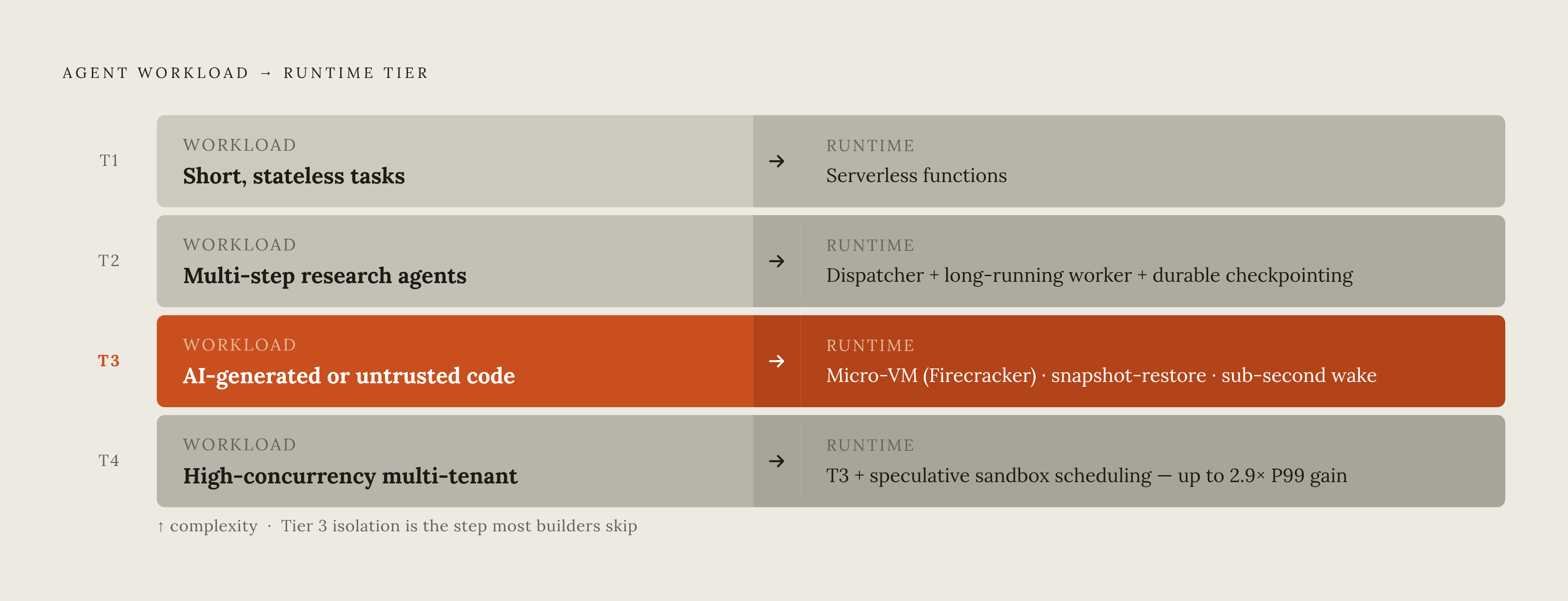
Short, event-driven, stateless tasks such as classification, summarization, and one-shot tool calls remain appropriate for serverless functions. They benefit from zero idle cost and automatic scaling without operating a persistent execution tier. Persistence would add little to that workload profile.
Multi-step investigation workflows and research agents call for a different arrangement. A serverless dispatcher, long-running worker, and external state store separate request handling from execution, while durable checkpointing supports pauses and resumptions. Agents executing AI-generated or untrusted code should use persistent micro-VM runtimes when they need kernel-level isolation. Snapshot-restore scheduling lets those environments keep state while they sleep and wake in under a second.
High-concurrency, multi-tenant platforms with many sequential tool calls can add speculative sandbox scheduling above that persistent tier. The purpose is to overlap model inference with sandbox preparation. Most production teams will need multiple runtime tiers. A short classification task and an isolated coding agent need not share an execution model merely because both use an LLM.
When moving from prototype to production, builders should evaluate platforms offering an individual Firecracker micro-VM on bare metal for each agent, snapshot-restore scheduling, sub-second wake latency, and a flat monthly rate per agent. The commercial test is whether idle persistence is priced as storage. Teams should also plan from day one for visibility across every tier and intervention in runaway loops. Longer execution is useful only when the system can also stop it deliberately.