How to Hibernate AI Agents Between Tasks Without Dropping State or Paying for Idle Compute
Framework checkpoints cover workflow steps, but live machines need VM snapshots.

Snapshot-restore scheduling for idle AI agents saves the machine’s state, frees its compute, and restores it when work arrives. The agent costs only storage while dormant. Framework checkpoints are enough for agents that pause at known workflow boundaries, but preserving a live desktop, terminal, or mid-execution process requires an infrastructure solution alongside saved message history.
Why agents cannot simply pause and resume the way ordinary software can
An agent waiting for human approval before deploying to production may sit idle for 30 minutes. Keeping an open connection is not a workable persistence plan. The agent needs to preserve its tool outputs, intermediate variables, filesystem changes, open processes, and position in the workflow until approval arrives. A message log alone cannot capture all of that.
The model itself supplies none of this continuity. LLMs have no memory between API calls, so the application must put together the context the next call needs. Meanwhile, the tools and processes around the model accumulate their own state, which can disappear when the process stops. A sleeping process costs money for compute, while a cold restart wastes time and tokens fetching data again and may give a different answer.
What hibernation actually requires: the difference between serializing memory and serializing a machine
Saving a conversation preserves what the agent was told and what it said. In-context working memory holds conversation history, tool results, and system instructions, all of which must fit in the context window. Workflow state adds the current step, intermediate variables, branching flags, consumed budgets, and pending effects. Machine state adds process memory, open file descriptors, filesystem writes, the process table, network identity, and the execution stack.
These layers answer different questions about recovery. A workflow checkpoint tells the orchestrator where to continue, but it may leave the tools with work to reconstruct. A coding agent’s indexed repository or a research agent’s partially processed sources can be lost if only the conversation survives. Cognee’s 2026 agent state guide distinguishes run-scoped “agent state” from lifetime-scoped “agent memory”.
The choice of serialization layer determines what survives. Database recovery can put an agent at the right workflow step while still requiring it to fetch data or execute work again. A full machine snapshot instead preserves the paused execution itself. It can restore the process mid-execution rather than asking a fresh process to reconstruct it, though effects outside the machine still need separate handling.
How framework-level checkpointing works and where it reliably holds up
Database-backed checkpointing works well for agents whose work has clear boundaries. After a meaningful unit of work, the framework writes step position, message history, tool outputs, and metadata to durable storage such as PostgreSQL, SQLite, or Redis. A thread identifier ties those checkpoints to one run. A new process can then load the saved state and pick up without repeating finished steps, as far as the framework’s recovery semantics allow.
Human approval is a natural fit for this pattern. The agent saves its workflow state at the interrupt, releases compute, and waits for an external signal such as approval, a webhook, or a timer. Google’s Agent Development Kit uses a runtime that handles session persistence and scale-to-zero during idle time. Its checkpoint-and-resume architecture works with SQLite locally and with managed cloud storage in production, with no need to change the code. The workflow remains paused after its process releases compute.
A checkpoint also needs enough information to govern recovery. That includes a schema version, structured working state, consumed budgets, pending effects with idempotency keys, and run metadata. On resume, remaining budget must be calculated from what was already consumed. Otherwise, recovery can change the rules of the run. The hardest correctness issue, however, is idempotency, or whether a repeated attempt causes the same effect twice.
Why resuming from a checkpoint is harder to get right than it looks
An email can be sent before the framework records that its node finished. A crash in that gap leaves recovery with an awkward choice. Repeating the node may send the email again, just as repeating a payment or database write may duplicate an effect. Correct recovery requires state to be captured before side effects and resume logic to skip tool calls that already have results. Saving after completion alone leaves a gap.
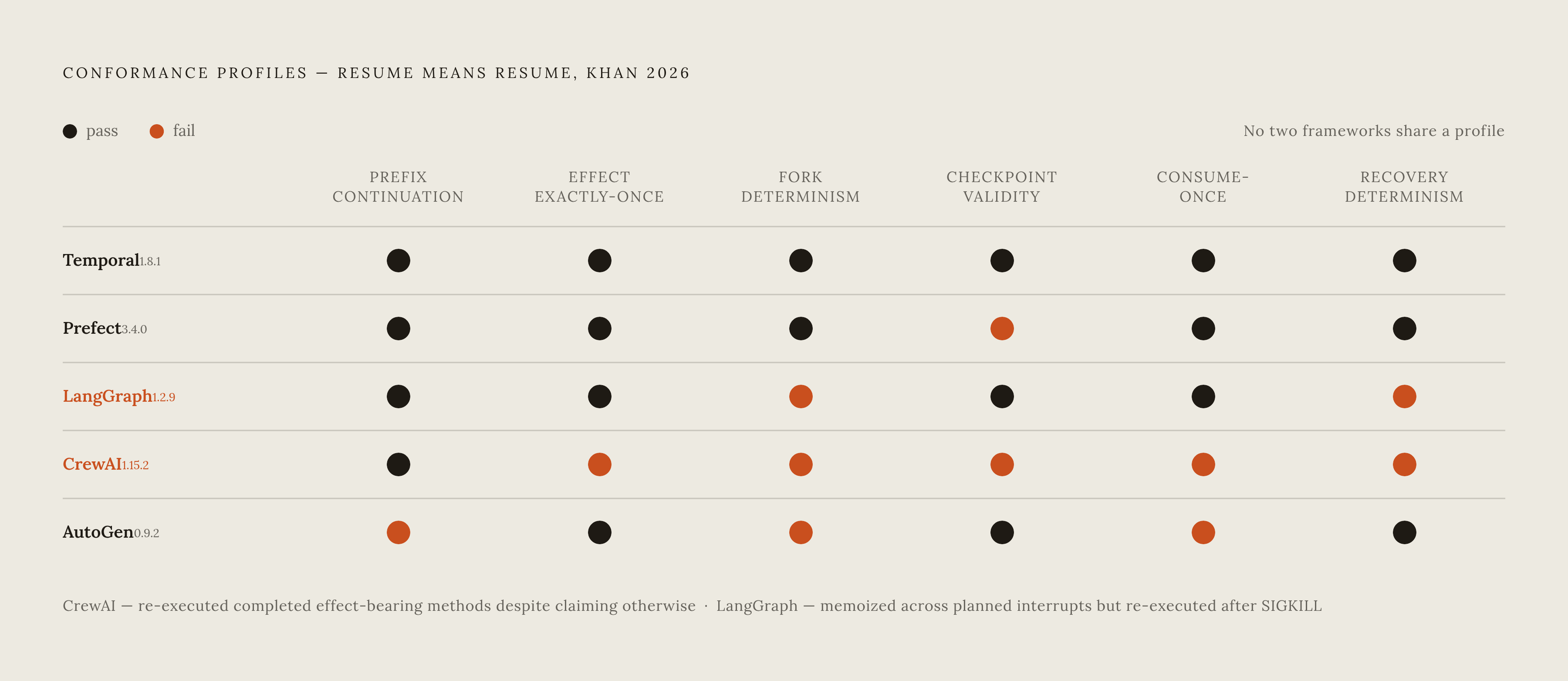
Sajjad Khan’s Resume Means Resume research, published in August 2026, measured five widely deployed agent workflow frameworks at pinned releases against a six-property conformance contract. The properties were prefix continuation, effect exactly-once, fork determinism, checkpoint validity, consume-once, and recovery determinism. No two frameworks shared a conformance profile. CrewAI 1.15.2 re-executed completed effect-bearing methods despite its written claim that restoration “resumes without re-running completed work”. pydantic-graph 1.x could not resume after a mid-node crash.
The same study found that LangGraph 1.2.9 memoized completed task results across interrupt-resume but re-executed durably recorded work after a real SIGKILL. A planned interruption and a crash therefore differed. LangGraph’s fault-tolerance documentation also warns that node retries provide at-least-once execution and may repeat external side effects. The research also reproduced concurrent delivery failures across hosts, where processes raced to resume a parked interrupt and each one fired the gated effect.
A workflow that gates non-idempotent actions such as payments, messages, or writes needs an explicit application-layer idempotency key strategy alongside documented resume behavior. A durable checkpoint does not, by itself, make an external action happen only once.
What VM-level snapshots add that framework checkpointing cannot provide
A full VM snapshot solves a different recovery problem. Rather than record the workflow’s description of progress, it freezes the machine that is doing the work. Firecracker microVM snapshots save the VM’s in-memory state at the hypervisor level, including the execution stack, process table, open file handles, and network state. On restore, execution continues from the precise instruction where it paused. The framework does not need to rebuild that runtime from a message history.
The isolation boundary is the whole machine. Each microVM has its own Linux kernel, so its process runs on a kernel separate from those of other containers. That gives the snapshot a defined machine boundary around the running environment. Alibaba Cloud open-sourced OpenSandbox in March 2026 as a container-level unified API execution layer for AI agents, with optional gVisor or Kata isolation. That is a distinct execution and isolation approach whose snapshot-state equivalence to a microVM snapshot requires separate evidence.
This is the infrastructure solution to idle runtime cost. Once the VM state is stored and its compute released, the dormant agent needs only snapshot storage. Per-second compute billing can then charge for the time the agent runs and stop charging while it waits for approval. The snapshot preserves local execution, however, while an external system’s treatment of a restored request as new or already completed remains uncertain.
How do you choose the right hibernation mechanism for your workload?
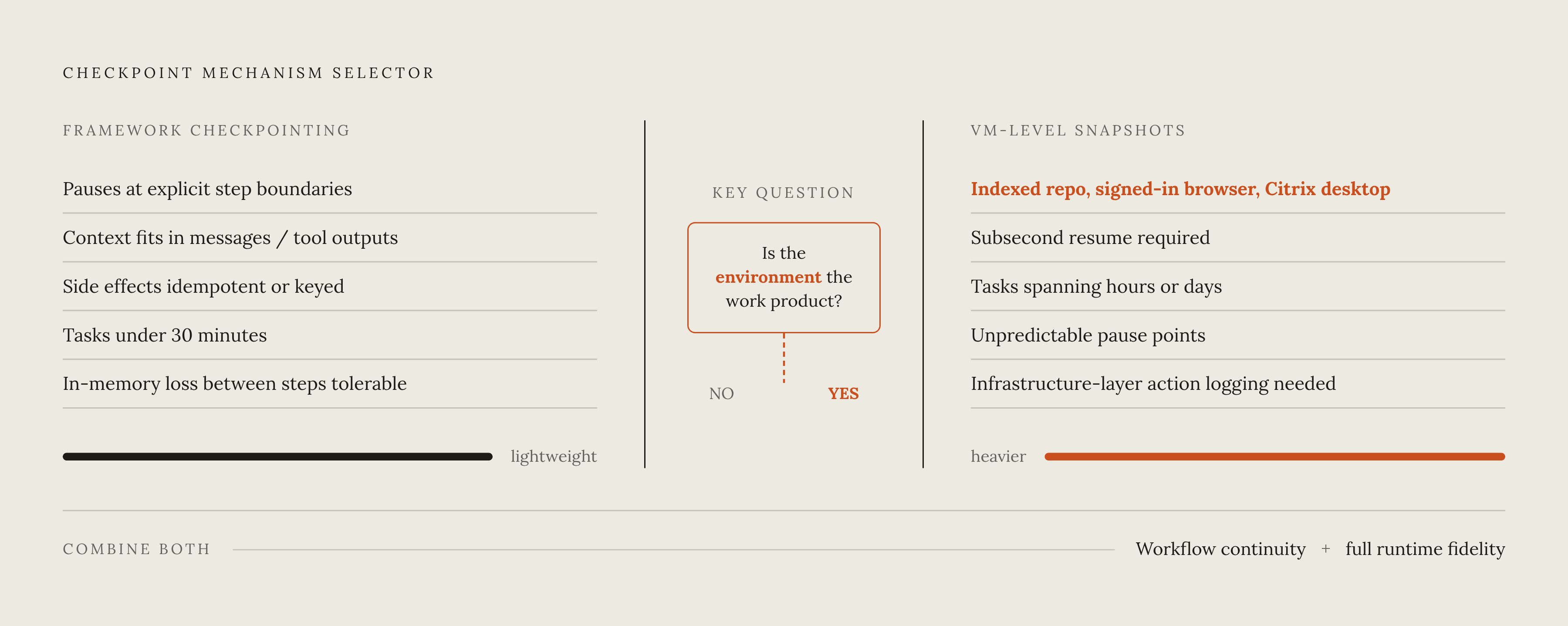
Framework checkpointing is enough when the agent pauses at explicit step boundaries and can safely pick up from saved state. Its working context must fit within the persisted messages, tool outputs, and structured workflow data. Side effects must also be idempotent or have application-layer keys to protect them. This works for short tasks under 30 minutes when it is okay to lose in-memory work between checkpoints if the process crashes.
VM snapshots fit workloads where the environment is part of the work product. Examples include a coding agent with an indexed repository, a computer-use agent with a signed-in browser, or a Windows agent inside a Citrix environment. They are also the appropriate mechanism when a workload requires subsecond resume without visible interruption, or tasks stretch across hours or days with unpredictable pauses. A need for full infrastructure-layer action logging may be another reason to choose this layer. Workflow checkpoints cannot substitute for the desktop or terminal itself.
Evaluation and RL rollout pipelines have a different goal. They launch thousands of identical environments from clean snapshots and discard each episode’s state when it ends, prioritizing throughput. CUA-Gym describes a router that selects an idle VM, restores the task’s configured snapshot, and returns per-step screenshots and rewards to the trainer. After episode termination, the VM resets to a clean snapshot before returning to the pool. Production agents that need both workflow continuity and full runtime fidelity can instead combine checkpoints and machine snapshots.
What hibernating agents in regulated industries adds: audit trails, HIPAA, and minimum-necessary access
In healthcare, lending, and insurance, a pause must not break the record of what the agent did. Actions before and after hibernation need an audit trail with actor identity, timestamp, and purpose. Legacy desktop environments make this harder because the underlying application may have no API to instrument. Citrix-hosted EHRs, loan origination systems, and document management systems are examples. Their agents need infrastructure-layer logging of clicks, keystrokes, and form fills as well as a record of finished workflow nodes.
HIPAA obligations attach to data access regardless of the technology performing it. An agent querying a patient record, retrieving a lab result, or generating a clinical summary performs a regulated access event. Broad system permissions do not settle minimum-necessary access. An agent needs operation-level controls that limit it to the PHI its specific function requires. Hibernation preserves access state, so this question follows the agent through the pause.
The snapshot itself can become the compliance boundary. If it contains cached PHI or persistent session tokens, the BAA must cover the specific product and tier storing it. There is no HIPAA certification for an agent platform. What can be evidenced is a posture built from signed BAAs with every vendor in the data path, Security Rule safeguards for the snapshot store and resume path, and a written risk analysis naming the agent and its hibernation mechanism. A stored machine image is not exempt because it is dormant.
What to watch for when framework semantics and machine-state snapshots are combined in production
Combining the layers introduces an ordering problem. If a framework checkpoint says step 7 is complete while VM memory reflects step 6, restore brings back conflicting versions of progress. The fix is to trigger the machine snapshot only after the framework checkpoint has durably committed. That ordering gives the two records a consistent basis for recovery.
An in-flight network call or file write may execute again when a snapshot is restored after a crash. Application-layer idempotency keys are still needed for non-idempotent effects that cross that boundary. Snapshot contents also need their own retention and access controls. Framework checkpoints are run-scoped and expire when a thread closes, while machine images may hold session tokens, cached credentials, or facts gathered during earlier runs. Those contents need the same treatment as long-term memory.
A hibernated VM incurs snapshot storage cost, a live sleeping process incurs compute cost, and framework checkpointing incurs database reads and writes. Snapshot-sleep is the better default for the workload when compute cost dominates, while always-on is better when snapshot storage cost dominates. Each version of “pause” has its own mechanism and bill.
Human takeover provides a final practical distinction. A snapshot-hibernated VM can resume so an operator can inspect or take over the desktop. For workloads that need this capability, preserving the machine is a required part of preserving the work alongside message history.